.png)
Anesthesia services for head procedures represent some of the highest-acuity and most technically demanding cases in surgical care. The CPT code range 00100–00222 encompasses anesthesia provided for intracranial surgeries, skull and facial procedures, and complex ear, nose, and throat operations. These cases often require advanced airway management, invasive monitoring, and precise hemodynamic control, making accurate, detail-driven billing essential for proper reimbursement.
Because anesthesia reimbursement is based on a unit-based formula rather than a flat procedural fee, understanding how base units, time units, physical status modifiers, and medical direction rules apply is essential. Even minor documentation or modifier errors can significantly affect payment and increase audit risk.
This comprehensive guide breaks down everything you need to know about anesthesia CPT codes 00100–00222, including code structure, reimbursement methodology, modifier selection, CMS medical direction requirements, documentation standards, compliance considerations, and best practices for defensible billing.
Table of Contents
- What Do CPT Codes 00100–00222 Cover in Head Procedure Anesthesia?
- How Anesthesia Reimbursement Works
- Base Units for Head Anesthesia Codes
- How Are Time Units Calculated in Anesthesia Billing?
- What Are ASA Physical Status Modifiers (P1–P6) in Anesthesia Billing?
- Anesthesia Modifiers and Their Impact
- Centers for Medicare & Medicaid Services (CMS) Medical Direction Requirements
- Documentation Requirements for Head Procedures
- Special Considerations for Neurosurgical Cases
- What Are Qualifying Circumstances Codes in Anesthesia Billing?
- Common Billing Errors for 00100–00222
- What Are the Compliance and Audit Risks in Anesthesia Billing?
- Revenue Optimization Strategies for Head Procedure Anesthesia Billing
- How Do Conversion Factors Impact Anesthesia Reimbursement?
- Future Trends in Head Procedure Anesthesia Billing
- Summit RCM: Your Trusted Partner in Anesthesia Billing
What Do CPT Codes 00100–00222 Cover in Head Procedure Anesthesia?
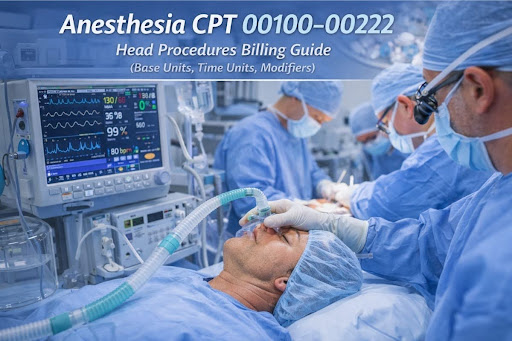
The CPT code range 00100–00222 represents anesthesia services provided for procedures on the head. These codes are categorized by anatomical region and surgical complexity rather than by anesthesia technique.
Procedures commonly associated with this range include:
- Craniotomy
- Brain tumor resection
- Skull fracture repair
- Facial bone surgery
- Deep ENT procedures
- Intracranial vascular procedures
- Neurosurgical interventions
Head procedures frequently involve airway challenges, neurological monitoring, and hemodynamic instability. As a result, many of these codes carry higher base unit values compared to anesthesia for extremity procedures.
How Anesthesia Reimbursement Works
Unlike surgical CPT codes, anesthesia billing follows a distinct formula:
- (Base Units + Time Units + Modifying Units) × Conversion Factor = Total Reimbursement
Understanding each component is critical for accurate billing.
Base Units for Head Anesthesia Codes
Each anesthesia CPT code has a predetermined number of base units assigned by the American Society of Anesthesiologists (ASA) and recognized by CMS and commercial payers.
Base units reflect:
- Complexity of the surgical procedure
- Level of risk involved
- Skill required to manage anesthesia
- Physiologic stress placed on the patient
- Head and intracranial procedures generally carry higher base units due to:
- Airway management complexity
- Risk of neurological compromise
- Hemodynamic instability
- Need for invasive monitoring
- For example:
- Minor head procedures may carry lower base units
- Intracranial surgeries often carry significantly higher base units
Accurate base unit verification before claim submission is essential.
How Are Time Units Calculated in Anesthesia Billing?
Time is a fundamental component of anesthesia reimbursement.
Anesthesia time begins when the anesthesia provider:
- Starts preparing the patient for anesthesia in the operating room or equivalent setting
- Time ends when:
- The patient is safely transferred to post-anesthesia care and monitoring is no longer required
- Most payers calculate:
- One time unit per 15 minutes
- For example:
- 60 minutes = 4 time units
- 150 minutes = 10 time units
Precise start and stop time documentation is mandatory. Inconsistencies between the anesthesia record and facility documentation can trigger audits.
What Are ASA Physical Status Modifiers (P1–P6) in Anesthesia Billing?
Physical status modifiers indicate the patient’s preoperative condition. They can affect reimbursement depending on payer policy.
P1 – Normal healthy patient
P2 – Mild systemic disease
P3 – Severe systemic disease
P4 – Severe systemic disease that is a constant threat to life
P5 – Moribund patient not expected to survive without the operation
P6 – Brain-dead patient for organ donation
Head surgeries frequently involve higher physical status classifications, especially in trauma or emergent neurosurgical cases.
Accurate documentation supporting the assigned physical status is essential for compliance.
Anesthesia Modifiers and Their Impact
Modifier selection directly affects reimbursement.
AA – Anesthesia Personally Performed
Used when the anesthesiologist performs the entire anesthesia service.
QK – Medical Direction of 2–4 Concurrent Cases
Reported by anesthesiologist when directing up to four CRNAs or residents.
QY – Medical Direction of One CRNA
Used when directing a single CRNA.
QX – CRNA With Medical Direction
Reported by CRNA when medically directed.
QZ – CRNA Without Medical Direction
Used when CRNA provides independent service.
AD – Medical Supervision
Applies when supervising more than four concurrent procedures.
Improper modifier combinations are among the most common audit triggers in anesthesia billing.
Centers for Medicare & Medicaid Services (CMS) Medical Direction Requirements
For medical direction reimbursement, CMS requires the anesthesiologist to:
- Perform a pre-anesthesia evaluation
- Prescribe the anesthesia plan
- Personally participate in critical portions
- Monitor at frequent intervals
- Remain immediately available
- Provide post-anesthesia care
All six requirements must be met. Missing documentation can reduce reimbursement to supervision levels.
Documentation Requirements for Head Procedures
Because head surgeries are often complex, documentation must be meticulous.
Required elements include:
- Pre-anesthesia evaluation
- Detailed airway assessment
- Anesthesia start and stop times
- Intraoperative monitoring notes
- Medications administered
- Invasive monitoring documentation
- Neuromonitoring coordination (if applicable)
- Transfer of care documentation
- ASA physical status
Time discrepancies are a leading cause of audit findings.
Special Considerations for Neurosurgical Cases
Intracranial and complex brain procedures present unique clinical and billing challenges. These cases often involve higher acuity, greater physiologic instability, and prolonged operative time, all of which directly impact anesthesia documentation and reimbursement.
When billing anesthesia for neurosurgical procedures, providers must account for several additional factors:
Extended Operative Duration
Neurosurgical cases frequently last several hours. Accurate start and stop time documentation is critical, as time units significantly influence total reimbursement. Any discrepancies between the anesthesia record and operative report can trigger payer review.
Advanced Hemodynamic and Neurologic Monitoring
Intracranial procedures often require invasive monitoring such as arterial lines, central venous access, or intracranial pressure management. While these services may be separately reportable in certain circumstances, documentation must clearly reflect medical necessity and provider participation.
Emergency Status Modifiers
Emergent neurosurgical interventions, including traumatic brain injuries or acute hemorrhages, may justify the use of emergency modifiers when supported by clinical documentation. Proper use of emergency designations can impact reimbursement but must be clearly substantiated in the record.
Qualifying Circumstances Codes (99100–99140, When Applicable)
Certain high-risk neurosurgical scenarios may support the reporting of qualifying circumstances add-on codes, such as those for emergency conditions or extreme patient age. These codes require explicit documentation of the qualifying condition.
Higher Physical Status Assignments
Emergent head trauma and critical intracranial cases frequently involve patients with severe systemic disease or life-threatening instability. In such cases, higher ASA physical status modifiers (such as P4 or P5) may be appropriate when clearly documented.
Because neurosurgical anesthesia cases are often high value and high complexity, they are more likely to be scrutinized by payers. Thorough documentation, accurate modifier usage, and strict adherence to CMS medical direction requirements are essential to ensure compliant and defensible reimbursement.
What Are Qualifying Circumstances Codes in Anesthesia Billing?
Qualifying circumstances codes are add-on CPT codes used to report unusual, high-risk conditions that significantly increase the complexity of anesthesia care. These codes do not replace the primary anesthesia CPT code; instead, they are reported in addition to it when specific clinical criteria are met.
In high-acuity head and neurosurgical cases, qualifying circumstances codes may apply when patient condition or intraoperative management substantially elevates risk.
Common Qualifying Circumstances Codes Include:
- 99100 – Extreme Age
Reported for patients at either end of the age spectrum when age materially increases anesthesia risk, typically for very young or elderly patients.
99116 – Anesthesia Complicated by Utilization of Total Body Hypothermia
Used when deliberate hypothermia is medically required and documented during the procedure.
99135 – Anesthesia Complicated by Controlled Hypotension
Reported when induced hypotension is necessary to reduce surgical bleeding and is clearly documented.
99140 – Anesthesia Complicated by Emergency Conditions
Used when a delay in treatment would significantly threaten life or limb, and the emergency status is clearly supported in the medical record.
Important Compliance Considerations
Qualifying circumstances codes are add-on services and must be:
- Supported by clear, specific documentation
- Clinically justified
- Consistent with operative and anesthesia records
These codes are subject to payer scrutiny, particularly in high-reimbursement cases. Proper documentation of medical necessity is essential to ensure compliant and defensible reporting.
Common Billing Errors for 00100–00222
Anesthesia claims for head procedures (CPT 00100–00222) are often high-value and high-risk, making accuracy essential. Even minor billing errors can lead to payment reductions, denials, or audit exposure. Because reimbursement is unit-based and modifier-driven, mistakes in calculation or documentation can significantly affect revenue.
Frequent Billing Errors Include:
- Incorrect Base Unit Selection
Using the wrong anesthesia CPT code or failing to verify assigned base units can immediately distort total unit calculation and reimbursement.
Inaccurate Time Reporting or Improper Rounding
Anesthesia time must reflect precise start and stop times. Over-rounding, under-reporting, or inconsistencies between records can trigger payer scrutiny.
Improper ASA Physical Status Assignment
Assigning higher physical status modifiers (such as P4 or P5) without clear clinical documentation may be interpreted as upcoding.
Failure to Meet Medical Direction Requirements
Missing documentation of required anesthesiologist participation in medically directed cases can result in downcoding from medical direction to medical supervision.
Overlapping Concurrency Documentation
Improper reporting of concurrent cases beyond CMS limits can lead to payment reductions or recoupments.
Incorrect Modifier Pairing
Mismatched modifiers between anesthesiologist and CRNA claims (e.g., QK without QX) are a common audit trigger.
Because each of these errors directly impacts total unit calculation or compliance status, they can significantly reduce reimbursement and increase regulatory risk. Careful review, structured documentation practices, and routine internal audits are essential to prevent costly billing mistakes.
What Are the Compliance and Audit Risks in Anesthesia Billing?
Anesthesia billing, particularly for head and neurosurgical procedures, carries heightened audit exposure due to its unit-based reimbursement structure and higher average claim value. Because these cases often generate significant reimbursement, they are more likely to be analyzed through payer data analytics and utilization benchmarking.
Common Audit Triggers Include:
- Excessive time units compared to national or regional benchmarks
Outlier time reporting patterns can quickly draw payer scrutiny.
Frequent reporting of high ASA physical status (P4 or P5)
Overuse without clear clinical documentation may suggest inappropriate upcoding.
Improper application of emergency modifiers
Emergency designations must be supported by clear operative and anesthesia documentation.
Modifier mismatches between anesthesiologist and CRNA claims
Inconsistent modifier pairing (e.g., QK without corresponding QX) can trigger claim review.
Failure to document critical participation in medically directed cases
Missing documentation of the anesthesiologist’s required involvement under CMS rules may result in reduced reimbursement.
Because anesthesia reimbursement is data-driven and highly regulated, routine internal compliance reviews are not optional. They are a financial safeguard.
Revenue Optimization Strategies for Head Procedure Anesthesia Billing
Optimizing anesthesia reimbursement requires a balance between accuracy, compliance, and proactive oversight. The following strategies help ensure defensible and optimized billing:
- Verify assigned base units for each CPT code prior to submission
Incorrect base units directly impact total reimbursement.
Track anesthesia start and stop times in real-time
Avoid retrospective time estimation, which increases audit risk.
Clearly document participation in critical portions of the procedure
Particularly important for CMS medical direction compliance.
Review modifier combinations carefully before claim submission
Ensure alignment between anesthesiologist and CRNA claims.
Monitor concurrency daily
Prevent accidental violations of medical direction limits.
Provide ongoing education on CMS medical direction requirements
Clinical staff must understand documentation expectations.
Conduct quarterly compliance audits
Early detection of billing inconsistencies prevents costly recoupments.
Proactive oversight significantly reduces denials, repayment demands, and prepayment review exposure.
How Do Conversion Factors Impact Anesthesia Reimbursement?
Anesthesia reimbursement is calculated using the formula:
- Total Units × Payer Conversion Factor = Payment
Even when coding and documentation are accurate, payment ultimately depends on the applicable conversion factor.
Conversion Factors Vary Based On:
- Medicare locality adjustments
Geographic regions have different conversion factor rates under the Medicare Physician Fee Schedule.
Commercial payer contracts
Negotiated contract terms may produce higher or lower reimbursement rates.
Facility type
Hospital-based versus ambulatory surgery center settings may affect payment structures.
Because conversion factors are updated annually, especially under Medicare, practices should closely monitor fee schedule changes to forecast revenue fluctuations and adjust financial planning accordingly.
If your practice provides wound care services, our guide on How Wound Care Billing Services Boost Practice Revenue explains how specialized billing support can significantly improve collections and reduce denials.
Future Trends in Head Procedure Anesthesia Billing
The anesthesia billing landscape continues to evolve, particularly in high-acuity specialties such as neurosurgery.
Emerging Trends Include:
- Increased scrutiny of high-acuity and high-reimbursement cases
Payers are leveraging advanced analytics to identify outlier billing patterns.
Expansion of outpatient neurosurgical procedures
More complex procedures are shifting to ambulatory settings, increasing documentation demands.
Greater utilization of CRNA-led care models
This shift heightens the importance of accurate modifier usage and concurrency compliance.
More frequent prepayment reviews and focused audits
Head procedures are often targeted due to their higher reimbursement profile.
Data-driven audit algorithms
Automated systems now flag irregular time reporting, modifier usage, and physical status patterns.
As scrutiny increases, practices must prioritize meticulous documentation, strict compliance oversight, and structured internal audit processes. Strong systems today prevent costly regulatory challenges tomorrow.
For practices aiming to grow strategically while reducing administrative workload, our article What Can a Digital Marketing Virtual Assistant Do for Your Practice? explains the measurable impact of digital support.
Summit RCM: Your Trusted Partner in Anesthesia Billing
CPT codes 00100–00222 represent anesthesia services for head procedures, including some of the most complex and high-risk surgical cases. Accurate billing requires thorough knowledge of base unit assignments, precise time reporting, correct modifier application, and strict adherence to CMS medical direction rules.
Because anesthesia reimbursement follows a unit-based methodology, even small documentation errors can significantly impact revenue and compliance exposure. Head procedures, in particular, demand heightened attention to detail due to their complexity and higher reimbursement value.
At Summit RCM, we support specialty practices with comprehensive revenue cycle solutions designed to strengthen accuracy and compliance across service lines. Whether your practice requires focused anesthesia billing support, dedicated Wound Care Billing Services, or administrative assistance through our Virtual Medical Assistant (VMA) Services, our team helps streamline documentation, improve charge capture, reduce denials, and enhance overall operational efficiency.
If your organization is looking to optimize reimbursement while minimizing audit risk, Summit RCM is here to help. Partner with us to turn anesthesia billing complexity into streamlined, compliant, and confidently managed revenue.