.png)
CPT codes 01462–01522 are used to report anesthesia services for procedures involving the lower leg, ankle, and foot, including structures below the knee such as the tibia, fibula, arteries, veins, muscles, tendons, and ankle joints. These surgeries are commonly performed in orthopedic, vascular, and podiatric procedures.
Unlike most medical services, anesthesia billing follows a unit-based system that includes base units, time units, and modifiers. Because of this structure, correct CPT code selection and proper documentation are critical to avoid claim denials, underpayments, and compliance issues.
This guide explains how CPT codes 01462–01522 are used for lower leg anesthesia services, how anesthesia units are calculated, which modifiers apply, and what documentation is required for accurate billing and optimal reimbursement.
Table of Contents
- Overview of CPT Codes 01462–01522
- CPT Codes Breakdown: 01462–01522
- Structure of Anesthesia Billing
- Base Units for CPT 01462–01522
- Time Units Calculation
- Important Anesthesia Modifiers
- Qualifying Circumstances
- Required Documentation for Anesthesia Billing
- Anesthesia Documentation Template
- Example Billing Scenario
- Common Billing Errors to Avoid
- Tips to Improve Anesthesia Reimbursement
- Improve Anesthesia Billing Accuracy and Efficiency with Summit RCM
Overview of CPT Codes 01462–01522
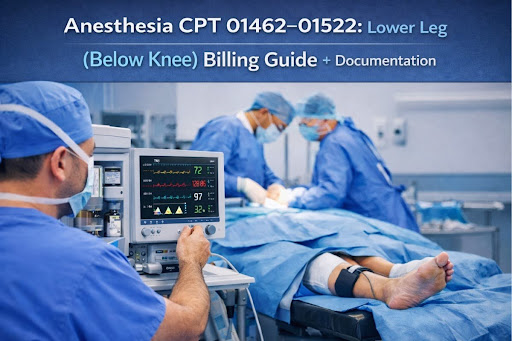
The CPT code range 01462–01522 is used for anesthesia services related to surgical procedures performed on the lower leg and foot. These codes apply to surgeries performed on anatomical structures below the knee, including bones, muscles, tendons, arteries, veins, ankle joints, and foot structures.
Anatomical Coverage
Procedures covered under this CPT range may involve the following areas:
- Tibia
- Fibula
- Lower leg arteries and veins
- Muscles and tendons of the lower leg
- Ankle joint
- Foot structures
These procedures are commonly performed by orthopedic surgeons, vascular surgeons, and podiatrists.
Common Surgical Procedures
Typical procedures requiring anesthesia under these codes include:
- Tibia and fibula fracture repair
- Tendon reconstruction surgery
- Fasciotomy for compartment syndrome
- Vascular repair of lower leg arteries
- Ankle arthroscopy
- Foot reconstruction procedures
- Ligament repair surgery
Because many of these procedures involve moderate to high surgical complexity, anesthesia providers must carefully monitor the patient and maintain detailed records.
Importance of Correct Code Selection
Selecting the correct anesthesia CPT code ensures that providers are compensated appropriately for the complexity of the procedure and the time required to administer anesthesia safely.
Incorrect code selection may lead to:
- Claim denials
- Reduced reimbursement
- Compliance violations
- Audit risk
CPT Codes Breakdown: 01462–01522
Understanding the specific applications of each CPT code in this range is essential for proper billing.
CPT 01462 – Lower Leg Vein Procedures
This code is used when anesthesia is administered for procedures involving veins of the lower leg.
Examples include:
- Varicose vein surgery
- Venous ligation
- Vein stripping procedures
These procedures are commonly performed in outpatient surgical centers and hospitals.
Typical base units are approximately 5 units, though this may vary by payer.
CPT 01464 – Lower Leg Artery Procedures
This code applies to anesthesia services provided during surgeries involving arteries of the lower leg.
Examples include:
- Arterial bypass surgery
- Arterial repair procedures
- Thrombectomy
Because vascular surgeries can involve significant risk and complexity, anesthesia providers must maintain continuous monitoring and careful management of the patient’s circulatory status.
CPT 01470 – Muscle and Tendon Procedures
This code is used for anesthesia services associated with procedures involving muscles, tendons, and fascia of the lower leg.
Examples include:
- Tendon repair surgery
- Fasciotomy procedures
- Soft tissue reconstruction
These surgeries are often performed in sports medicine and orthopedic care.
CPT 01472 – Lower Leg Bone Procedures
CPT 01472 is commonly used for anesthesia during procedures involving bones of the lower leg, particularly the tibia and fibula.
Examples include:
- Fracture repair surgery
- Internal fixation procedures
- Bone grafting
Bone surgeries often require longer anesthesia time and careful patient monitoring due to the complexity of the procedure.
CPT 01502 – Ankle Joint Procedures
This code applies to anesthesia services during surgeries involving the ankle joint.
Examples include:
- Ankle arthroscopy
- Ligament reconstruction
- Ankle fracture repair
These procedures may involve regional anesthesia techniques such as spinal blocks or nerve blocks.
CPT 01520–01522 – Foot Procedures
These codes are used for anesthesia during various foot surgeries, including:
- Foot reconstruction procedures
- Bunion correction surgery
- Tendon transfers
- Complex podiatric procedures
The complexity of these procedures can vary depending on the patient’s condition and surgical requirements.
Structure of Anesthesia Billing
Anesthesia reimbursement generally includes the following elements:
- Base units
- Time units
- Physical status modifiers
- Qualifying circumstances
Each of these elements contributes to the final calculation of reimbursement.
Standard Anesthesia Billing Formula
Most anesthesia payments follow a standardized formula:
Total Units = Base Units + Time Units + Modifier Units
The total units are then multiplied by a payer-specific conversion factor.
Total Payment = Total Units × Conversion Factor
Conversion factors vary by insurance payer, geographic region, and contract agreements. Understanding this formula is essential for accurate anesthesia billing.
Base Units for CPT 01462–01522
Base units represent the relative complexity of the anesthesia service associated with a specific procedure.
Base units take into account factors such as:
- The level of anesthesia skill required
- Surgical risk level
- Patient monitoring needs
Below is an example of typical base units for these CPT codes.
| CPT Code | Procedure Type | Base Units |
|---|---|---|
| 01462 | Lower leg veins | 5 |
| 01464 | Lower leg arteries | 6 |
| 01470 | Muscles and tendons | 4–5 |
| 01472 | Bones of lower leg | 5 |
| 01502 | Ankle procedures | 5 |
| 01522 | Foot procedures | 4 |
Base units are established by the American Society of Anesthesiologists (ASA) and should always be verified using the ASA Relative Value Guide.
Time Units Calculation
Time is a major factor in anesthesia reimbursement.
Anesthesia time begins when the anesthesia provider starts preparing the patient for anesthesia administration in the operating room or procedural area. Anesthesia time ends when the patient is safely transferred to post-anesthesia care, and monitoring is no longer required.
Standard Time Unit Rule
Most insurance payers follow this rule:
1 Time Unit = 15 Minutes
Time Unit Example
| Minutes | Time Units |
|---|---|
| 15 | 1 |
| 30 | 2 |
| 45 | 3 |
| 60 | 4 |
Example Billing Calculation
Procedure: Tibia fracture repair
CPT Code: 01472
Base Units = 5
Anesthesia Time = 60 minutes
Time Units = 4
Total Units:
5 + 4 = 9 units
If the conversion factor is $22, the estimated reimbursement would be:
9 × $22 = $198
Important Anesthesia Modifiers
Modifiers provide additional information about who performed the anesthesia service and the patient’s physical condition.
Provider Modifiers
These modifiers identify whether the anesthesia was provided by an anesthesiologist or a CRNA.
AA Modifier: Used when anesthesia services are performed personally by an anesthesiologist.
QK Modifier: Indicates medical direction of two to four CRNAs by an anesthesiologist.
QY Modifier: Used when an anesthesiologist medically directs one CRNA.
QX Modifier: Indicates a CRNA service with medical direction.
QZ Modifier: Used when a CRNA performs anesthesia without medical direction.
Physical Status Modifiers
These modifiers describe the patient’s overall health condition before surgery.
| Modifier | Description |
|---|---|
| P1 | Healthy patient |
| P2 | Mild systemic disease |
| P3 | Severe systemic disease |
| P4 | Severe disease threatening life |
| P5 | Moribund patient |
| P6 | Brain-dead organ donor |
Some insurance payers may add additional units for higher-risk physical status levels.
Qualifying Circumstances
Certain unusual anesthesia conditions may qualify for additional CPT codes.
Common Qualifying Circumstances Codes
| CPT Code | Description |
|---|---|
| 99100 | Extreme patient age |
| 99116 | Hypothermia during anesthesia |
| 99135 | Controlled hypotension |
| 99140 | Emergency anesthesia |
These codes recognize situations that require extra monitoring, specialized anesthesia techniques, or higher patient risk management.
Required Documentation for Anesthesia Billing
Proper documentation supports both accurate coding and regulatory compliance.
Pre-Anesthesia Evaluation
The anesthesia provider should document:
- Patient medical history
- Current medications
- Allergies
- ASA physical status classification
Anesthesia Start and Stop Time
Clear documentation of anesthesia start time and stop time is essential for calculating time units.
Type of Anesthesia
Examples include:
- General anesthesia
- Regional anesthesia
- Spinal anesthesia
- Local anesthesia with sedation
Intraoperative Monitoring
Documentation should include:
- Vital signs monitoring
- Oxygen saturation
- Medications administered
Post-Anesthesia Evaluation
After the procedure, the provider should document:
- Patient recovery status
- Pain level
- Any complications
Anesthesia Documentation Template
A standardized template can help ensure that all required documentation elements are recorded.
Patient Information
- Patient Name
- Date of Birth
- Medical Record Number
Pre-Operative Assessment
- ASA Physical Status
- Planned Procedure
- Medical History
- Allergies
Anesthesia Plan
- Type of Anesthesia
- Airway Assessment
- Monitoring Plan
Anesthesia Time
- Start Time
- End Time
- Total Anesthesia Minutes
Intraoperative Notes
- Vital Signs Monitoring
- Medications Administered
- Complications if Present
Post-Anesthesia Evaluation
- Patient Condition
- Pain Level
- Recovery Status
Example Billing Scenario
Consider the following example.
Procedure: Tibia fracture repair
Anesthesia CPT Code: 01472
Patient Status: P2
Anesthesia Time: 75 minutes
Time units calculation:
75 ÷ 15 = 5 units
Base units = 5
Total units:
5 + 5 = 10 units
If the payer conversion factor is $22, the estimated reimbursement would be:
10 × $22 = $220
Example claim code:
01472-AA-P2
Common Billing Errors to Avoid
Even experienced billing teams sometimes make errors when submitting anesthesia claims.
1. Incorrect CPT Code Selection
One common mistake is selecting the anesthesia code based solely on the surgeon’s procedure instead of the appropriate anesthesia code category.
2. Incorrect Anesthesia Time Documentation
Common time errors include:
- Missing start or stop times
- Including pre-operative evaluation time
- Including recovery room monitoring time
Only actual anesthesia administration time should be reported.
3. Missing Required Modifiers
Failing to include required modifiers such as AA, QK, QX, or QZ often leads to claim rejection.
4. Incorrect Base Units
Always verify base units using the ASA Relative Value Guide.
5. Insufficient Documentation
Incomplete documentation is one of the most common causes of insurance claim denials and audits.
Tips to Improve Anesthesia Reimbursement
Improving anesthesia billing processes can significantly reduce claim denials and increase revenue.
1. Maintain Accurate Documentation
Detailed documentation ensures that services are properly supported during audits and insurance reviews.
2. Verify Payer Rules
Different insurance companies may apply different rules for time calculation, modifiers, and qualifying circumstances.
3. Use Anesthesia Billing Software
Specialized anesthesia billing systems help automate calculations and reduce manual errors.
4. Train Coding Staff Regularly
Regular training ensures billing teams stay updated with CPT code changes and payer policies.
Practices exploring outsourcing solutions may also benefit from understanding Medical Billing for Small Practice Growth and streamlining administrative workflows.
Improve Anesthesia Billing Accuracy and Efficiency with Summit RCM
Accurate billing for anesthesia CPT codes 01462–01522 requires correct code selection, time calculation, modifier use, and proper documentation. For practices seeking to optimize their revenue cycle and reduce administrative workload, partnering with an experienced billing provider can be highly beneficial.
Summit RCM offers professional support through its Virtual Medical Assistant services and specialized Wound Care Billing solutions, helping healthcare organizations improve operational efficiency, maintain billing accuracy, and achieve consistent reimbursement outcomes.