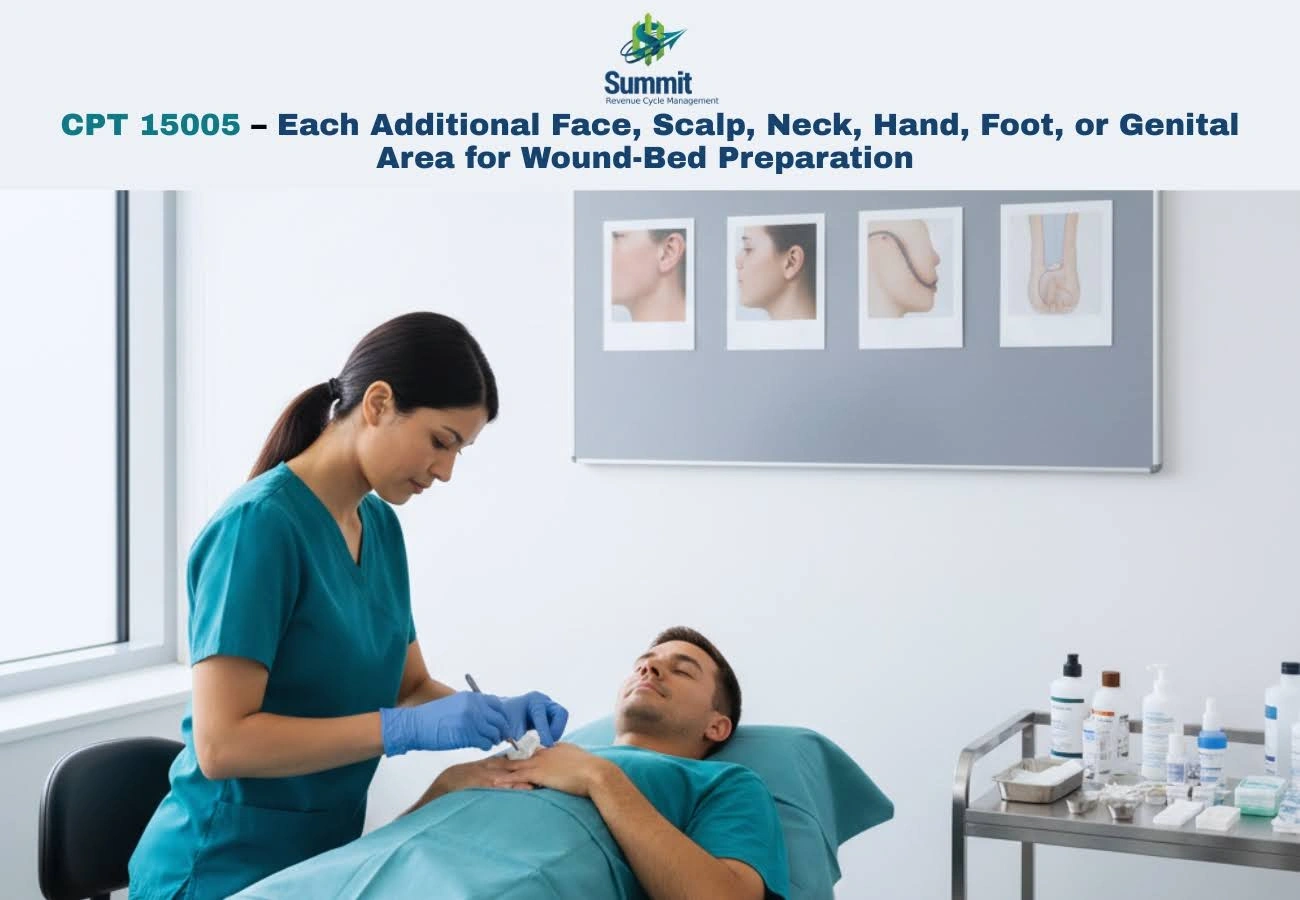
CPT 15005 is an add-on code used to report each additional 100 sq cm of surgical wound-bed
preparation, or each additional 1% body surface area in pediatric patients, when treating highly
sensitive anatomical areas such as the face, scalp, neck, hands, feet, or genitalia. This code
is always billed in conjunction with CPT 15004, which covers the first 100 sq cm.
Wound-bed preparation in these regions demands advanced surgical precision due to their
functional importance, cosmetic visibility, and heightened risk of complications. CPT 15005
ensures that the extra work required in larger or multiple wound areas is properly documented
and reimbursed.
This blog outlines how CPT 15005 is used to report additional wound-bed preparation in sensitive
areas, ensuring accurate coding and reimbursement for larger or complex cases.
What CPT 15005 Covers
Unlike the base code, CPT 15005 recognizes the increased surgical effort required when wound
preparation becomes more extensive, whether due to larger surface areas, deeper tissue
involvement, or the need for meticulous refinement in delicate anatomical regions. This code
ensures that the additional technical work and clinical judgment involved are accurately
reflected in the medical record.
Before applying CPT 15005, it is important to understand when additional wound-bed preparation
qualifies for this add-on code. The situations below outline the appropriate use of this code.
1. Wound Area Exceeds 100 sq cm
When the combined area of preparation surpasses the base allowance of CPT 15004, CPT 15005
should be added for each additional 100 sq cm (or portion thereof, when payer policy
allows).
2. Multiple Wounds in the Same Anatomical Category
Wounds on the face, scalp, or neck may be combined when clinically appropriate, and the
total area determines how many units of CPT 15005 are required.
3. Pediatric Body Surface Area (BSA) Rule
For children, CPT 15005 applies when the preparation area exceeds 1% BSA, matching CPT
15004’s pediatric threshold.
4. Never Reported Alone
CPT 15005 cannot be billed as a standalone code. It must always be listed alongside CPT
15004, as it represents additional work beyond the initial surgical preparation.
Anatomical Areas Included Under
CPT 15005
This add-on code applies exclusively to the same high-sensitivity regions covered by CPT 15004:
- Face
- Scalp
- Neck
- Hands
-
Feet
-
Genitalia
These locations pose unique challenges due to:
-
Cosmetic concerns (face, neck)
-
Functional importance (hands, feet)
-
Infection risk (scalp, genitalia)
CPT 15005 ensures clinicians are reimbursed for the extra surgical work required when these
areas involve extensive wound surfaces.
Coding Guidelines for CPT 15005
Accurately reporting CPT 15005 requires a clear understanding of how this add-on code
functions, how the wound area should be measured, and what documentation payers expect. The
guidelines below outline the key requirements for correct and compliant use of CPT 15005.
1. Always Paired With CPT 15004
CPT 15005 is an add-on code and can never be billed independently.
-
CPT 15004 must appear on the same claim to represent the first 100 sq cm or 1% BSA in
pediatric patients.
-
CPT 15005 then reports each additional 100 sq cm, or additional 1% BSA for pediatric
cases.
This pairing ensures the complete surgical effort is captured, especially in extensive
wounds.
2. Accurate Wound Measurement Is Essential
Precise wound measurement is foundational for proper CPT 15005 use. Providers must document:
- Length and width of each wound
- Total wound surface area in square centimeters
- Whether multiple wounds were combined or measured separately
When the wound area extends beyond the initial threshold for CPT 15004, CPT 15005 is added
in units representing each additional 100 sq cm or substantial portion thereof, depending on
payer guidelines.
3. Combine Wounds Only When Appropriate
Not all wounds should be combined for measurement. Correct application depends on both
anatomical location and clinical intent.
- Wounds within the same anatomic category (such as face and scalp) may be combined for
total area calculation.
- Wounds in different regions (such as the hand and neck) are measured and coded
separately, potentially requiring additional modifiers.
Understanding this distinction is key to avoiding underbilling or overbilling.
4. Detailed Documentation Supports Medical Necessity
To justify using CPT 15005, the operative note must clearly show that extra preparation work
was required beyond the initial 100 sq cm. Documentation should include:
- Description of additional surgical techniques used
- Extent and nature of extra tissue removal
- Any challenges related to wound complexity or depth
- Rationale for the need for expanded preparation before grafting
Payers may deny CPT 15005 if the documentation does not clearly differentiate it from the
base code.
5. Modifiers May Be Required for Separate Anatomical Sites
While CPT 15005 itself does not require modifiers, modifiers may be necessary when:
- Multiple anatomical areas are involved
- Separate operative fields are addressed during the same session
-
Common modifiers include 59 or XS to indicate distinct sites.
Proper modifier use prevents bundling errors and supports correct claim processing.
6. Follow Payer-Specific Instructions
Each payer may interpret or apply CPT 15005 slightly differently. Examples of variations
include:
- Whether partial 100 sq cm increments are reimbursable
- Whether photographic documentation is required
- Specific clinical criteria for determining medical necessity
Checking payer policies helps prevent rejections and ensures correct code application.
7. Confirm Intent for Skin Grafting
CPT 15005 should only be used when the surgical preparation is performed with the purpose of
supporting a skin graft.
If the wound is only being cleaned or debrided without graft intent, debridement codes
(11042–11047) should be used instead.
Clear documentation of graft intent is essential for compliance.
8. Ensure Coding Aligns With Operative Technique
Since CPT 15005 reflects an advanced surgical procedure, the operative report should
describe:
- Excisional or non-excisional preparation
- Removal of necrotic or fibrotic tissue
- Dermal or subdermal refinement
- Techniques used to improve vascularity
Coders should confirm that these elements are documented before assigning CPT 15005.
CPT 15005 Examples & Coding
Scenarios
Example 1: Large Scalp Wound
Total wound-bed preparation area: 180 sq cm
- 15004 for the first 100 sq cm
- 15005 × 1 for an additional 80 sq cm
Example 2: Multi-Region Preparation
- Face: 90 sq cm
- Neck: 50 sq cm
Combined within the same category → 140 sq cm total
- 15004 for the first 100 sq cm
- 15005 × 1 for the remaining 40 sq cm
Example 3: Pediatric Case
A child with wound-bed preparation totalling 2.2% BSA
- 15004 for the first 1% BSA
- 15005 × 1 for an additional 1%
- 15005 × 1 again for the remaining 0.2% (if payer allows rounding)
CPT 15005 vs. Related CPT
Codes
15004
Used for the first 100 sq cm of preparation; 15005 is only used after this threshold is met.
11042–11047 (Debridement Codes)
These do not represent surgical graft preparation. Use 15005 only when the intent is to
create a graft-ready bed.
15100–15278 (Graft Application Codes)
CPT 15005 is for preparation, not graft application. Both may be billed together when
performed and documented separately.
For additional details, read our comprehensive blog on CPT
and ICD-10 Codes in wound care
Even when providers and coders understand the basics of CPT 15005, certain recurring errors can
still lead to denials, underpayment, or compliance issues. Keeping an eye on the following
common mistakes can help protect both reimbursement and audit readiness.
-
Reporting CPT 15005 Without CPT 15004
CPT 15005 is an add-on code and cannot be billed alone. Submitting it without CPT 15004 on
the same claim will almost always result in denial.
-
Missing or Vague Wound Measurements
Simply stating “large wound” or “extensive area” is not enough. Failing to document exact
wound dimensions and total square centimeters makes it difficult to justify any units of CPT
15005.
-
Treating Debridement as Wound-Bed Preparation
Using CPT 15005 when only basic debridement was performed is a common error. If the
procedure does not clearly involve preparing a graft-ready bed, debridement codes
(11042–11047) are more appropriate.
-
Overlooking Combined vs Separate Areas
Incorrectly combining wounds from different anatomical regions (e.g., face and hand) or
failing to separate them when required can lead to undercoding or overcoding. Only combine
areas when they belong to the same anatomic category and when clinically appropriate.
-
Not Showing Additional Work Beyond 15004
If documentation does not clearly describe extra preparation beyond the first 100 sq cm,
payers may view CPT 15005 as unnecessary. The operative note should show what additional
work was done and over what added area.
-
Ignoring Payer Rules on Partial 100 sq cm Increments
Some payers have specific guidelines for rounding or billing a partial additional 100 sq cm.
Applying a “one-size-fits-all” approach without checking policies can cause denials or
underpayment.
-
Lack of Clear Graft Intent
CPT 15005 should only be used when the goal is to prepare for skin grafting. Not explicitly
stating graft intent in the record makes it easier for payers to recode the service as
simple debridement.
-
Incorrect or Missing Modifiers for Multiple Sites
When multiple distinct sites are involved, failing to use appropriate modifiers (such as 59
or XS, per payer rules) can result in services being bundled and partially unpaid.
Administrative efficiency supports stronger revenue performance. See how virtual medical assistant services
contribute.
Optimize Your Wound Care Billing With Summit RCM
CPT 15005 captures the additional surgical work involved in wound-bed preparation beyond the
first 100 sq cm in sensitive areas such as the face, scalp, neck, hands, feet, and genitalia.
When used together with CPT 15004, it helps ensure complex wound care is accurately documented,
medically justified, and appropriately reimbursed, while reducing denials and supporting
compliance.
For advanced wound care practices, navigating CPT 15004, 15005, and related codes can be
demanding without specialized support. Summit RCM provides focused wound care billing services with
precise coding, strong documentation review, and proactive denial management to streamline
workflows, minimize errors, and maximize reimbursement
Partner with Summit RCM today to ensure accurate, compliant wound care coding.
.png)