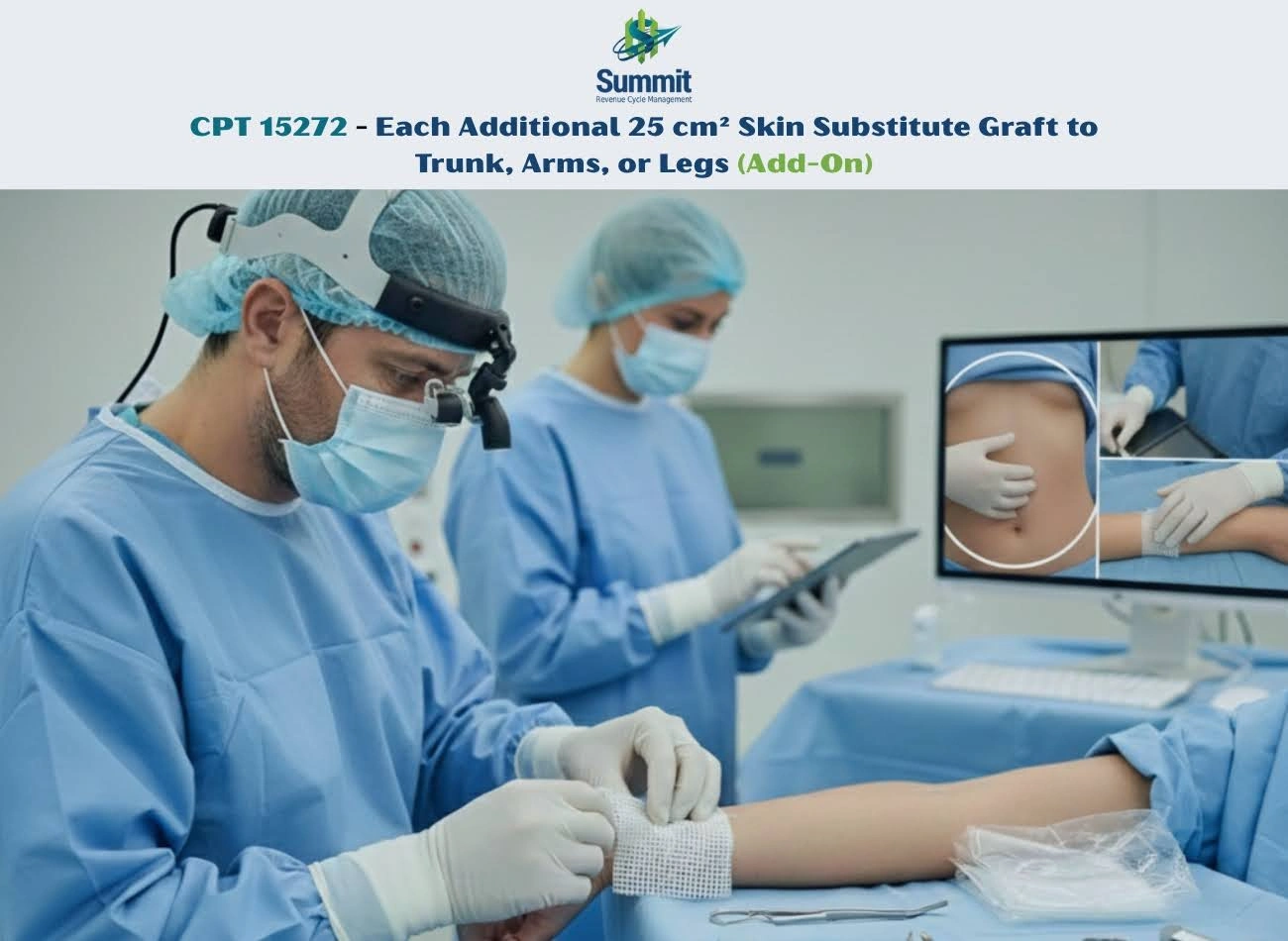
Precision in medical coding ensures fair reimbursement and accurate patient records. CPT 15272
represents each additional 25 cm² of skin substitute graft applied to the trunk, arms, or legs.
Accurate use of this code is important to maintain the integrity of clinical documentation while
supporting precise billing and optimal financial outcomes.
This detailed guide explains the purpose of CPT 15272, its relationship to primary codes 15271
and 15273, documentation essentials, billing examples, and compliance insights. By mastering
these details, you can streamline your wound care coding process, prevent denials, and ensure
your claims truly reflect the care delivered.
What Are Skin Substitute
Grafts?
Skin substitute grafts are biologic or synthetic materials used to cover wounds and support the
body’s natural healing process. They act as a temporary or permanent scaffold that helps
regenerate tissue, reduce infection risk, and promote wound closure. These products are often
used in:
-
Chronic wounds (e.g., diabetic foot ulcers)
-
Traumatic injuries
-
Surgical wound sites
-
Burns and reconstructive procedures
Skin substitutes can be derived from:
-
Allografts (human donor tissue)
-
Xenografts (animal-derived)
-
Engineered biologics or synthetics designed to mimic skin structure
Accurate coding is critical because these products can be expensive and require precise
documentation of area treated and clinical necessity.
The CPT Code Set for Skin
Substitute Grafts
The CPT codes used to represent skin substitute graft procedures range from 15271 to 15278. These
codes differentiate between:
-
Anatomical location (trunk/arms/legs vs. face/scalp/hands/feet)
-
Wound surface area size
-
Primary versus additional (add-on) coverage
Here’s an overview of how these codes are structured:
| CPT Code |
Description |
| 15271 |
Primary skin substitute application to trunk/arms/legs (first 25 cm²) |
| 15272 |
Each additional 25 cm² — Add-on code for trunk/arms/legs |
| 15273 |
Primary skin substitute application for ≥100 cm² (trunk/arms/legs) |
| 15274 |
Additional area ≥100 cm² — Add-on |
| 15275–15278 |
Analogous codes for face, scalp, hands, feet, etc. |
A clear understanding of this code family is essential. CPT 15272 is an add-on code, which means
it cannot be billed independently. It must be used with the appropriate primary code (e.g.,
15271 or 15273) when the treated wound size exceeds the base area.
What Exactly Is CPT 15272?
CPT 15272 is defined as:
Each additional 25 cm² wound surface area, or part thereof, requires skin substitute graft
coverage on the trunk, arms, or legs, listed in addition to the primary procedure code.
In simpler terms:
-
It is an add-on code for extra skin substitute graft coverage beyond the initial graft area
covered by the primary code.
-
The primary code for smaller wounds is 15271, which covers the first 25 cm².
-
Wound areas larger than 25 cm² require reporting CPT 15272 for every additional 25 cm² or
fraction of that measurement.
For example:
-
A wound of 50 cm² on the leg would require:
-
1 unit of 15271 (first 25 cm²)
-
1 unit of 15272 (additional ~25 cm²)
If the wound is 78 cm², it would be:
-
1 × 15271 for the first 25 cm²
-
3 × 15272 for the remaining 53 cm²
(because 53 cm² / 25 cm² ≈ 2.12 → round up to 3)
How CPT 15272 Interacts
With the Primary Procedure Code
15272 cannot stand alone. It is always used on the same claim as its primary code:
-
For wounds less then 100 cm² on trunk/arms/legs, 15271 is primary.
-
For wounds ≥100 cm², 15273 becomes primary, and then an add-on code is used (sometimes
15274).
This reflects a key CPT principle: add-on codes indicate additional work, resources, or
coverage beyond what’s included in the primary code. Add-on codes are listed separately but
only in conjunction with the main procedure.
Why Accurate Coding Matters:
Clinical and Financial Reasons
Accurate application of CPT 15272 has several important implications:
a. Proper Reimbursement
Skin substitute products and their application procedures are costly. Using the correct
number of add-on units ensures providers are reimbursed fairly for:
- Material costs
- Clinical time
- Procedure complexity
Medicare and many commercial payers calculate payment based on these codes and units.
Incorrect coding can lead to underpayment or denial.
b. Compliance
Insurance audits often focus on:
- Documentation of wound size
- Medical necessity
- Correct linkage between diagnosis and procedure codes
Incorrect use of add-on codes can trigger denials or require appeals.
c. Clinical Documentation
Accurate coding reflects exactly how much graft material was used and aligns with the
measured wound surface area, which is crucial for tracking patient outcomes and maintaining
quality of care.
Practical Tips for Coders and
Clinicians
Here are best practices when using CPT 15272:
Best Practices for CPT 15271 Documentation and Billing
-
Measure Wound Surface Area Carefully
Document wound size accurately in centimeters squared (cm²). Combine multiple wounds
only if they are in the same anatomical grouping.
Example:
- Wound A and B are both on the leg → add area together.
- One wound on the leg and another on the arm → still the same group
(trunk/arm/leg) and can be combined.
-
Always Link to Primary Code
For any additional units, always include 15271 or 15273 before listing 15272 units.
-
Rounding Rules
Round up to the next 25 cm² block. For example, a treated area measuring 45 cm² still
requires two 15272 units, covering 26–50 cm² and 51–75 cm².
-
Include Supporting Documentation
Document:
- Wound measurement method
- Clinical rationale for product choice
- Location and wound characteristics
This helps prevent denials and supports medical necessity.
-
Consider Appropriate Modifiers
Modifiers like 25 (significant, separate E/M service) or 59 (distinct procedural
service) may apply if separate services were provided on the same date. Check payer
guidelines for modifier rules.
Improving first-pass claim acceptance rates is easier when supported by virtual medical
assistant services that manage billing readiness tasks.
Practical Examples of CPT 15272 in
Clinical Use
Example 1: Moderate Leg Wound
John presents with a chronic ulcer on his lower leg measuring 48 cm². After debridement, a
skin substitute graft is applied to cover the wound.
| CPT Code |
Units |
Description |
| 15271 |
1 |
Primary skin substitute coverage (first 25 cm²) |
| 15272 |
1 |
Additional 25 cm² coverage (next 25 cm²) |
Because the wound area (48 cm²) exceeds 25 cm² but is less than 50 cm², one additional unit
of 15272 is appropriate.
Example 2: Larger Surface Area
A patient with a traumatic wound of 78 cm² on the thigh undergoes skin substitute
application.
| CPT Code |
Units |
| 15271 |
1 |
| 15272 |
3 |
The first 25 cm² is covered by 15271; the remaining ~53 cm² is rounded to 3 units of 15272
(each covers up to 25 cm²).
Documentation Must Support the
Coding
Medical necessity is the backbone of all billing. Ensure that the chart includes:
-
Wound measurements recorded accurately
-
Diagnosis codes that justify medical necessity
-
Orders, clinical notes, and wound care plans
-
Product types and units used
-
Treatment rationale
This ensures accurate coding and successful reimbursement.
Most Commonly Used Skin
Substitute Grafting Products
and MUE Limits
Accurate billing for skin substitute grafts requires a clear understanding of Medically
Unlikely Edit (MUE) limits. MUEs establish the maximum number of billable units allowed per
date of service and play a critical role in claim approval and reimbursement. The following
are commonly used skin substitute grafting products that are routinely reimbursed by
insurance payers, along with their associated HCPCS codes and MUE thresholds.
AmnioAMP mp (Q4250)
A placental derived allograft frequently used in the treatment of chronic and non
healing wounds. The MUE for AmnioAMP mp is 400 units per date of service, making precise
wound measurement and accurate unit calculation essential for compliant billing.
Esano ACA (Q4275)
Esano ACA is a widely utilized amniotic membrane product in outpatient and wound care
settings. Insurance reimbursement is generally limited to 300 units per date of service,
requiring detailed documentation of wound surface area.
Emerge (Q4297)
Often applied in the management of complex or difficult to heal wounds, Emerge carries
an MUE limit of 180 units per date of service. Proper documentation is necessary to
support medical necessity and prevent denials.
SimpliMax (Q4341)
Selected for its versatility across various wound types, SimpliMax has an MUE of 300
units per date of service. Accurate reporting of treated surface area helps ensure
correct reimbursement.
Activate (Q4301)
Activate allows for a higher volume of coverage compared to many other graft products,
with an MUE of 480 units per date of service. Thorough operative notes are critical to
justify the number of units billed.
Membrane Wrap (Q4205)
Membrane Wrap is commonly reimbursed for wound coverage and carries an MUE of 180 units
per date of service. Documentation should clearly support wound dimensions and product
utilization.
Exceeding MUE limits without appropriate modifiers or supporting documentation can trigger
claim denials, repayment requests, or audits. Providers and coders should ensure operative
reports clearly document wound size, total surface area treated, product selection, and
accurate unit calculation to remain compliant with payer policies and maximize
reimbursement.
Optimizing wound care coding directly impacts reimbursement—our article How
Wound Care
Billing Services Boost Practice Revenue explains how expert billing
services make a
difference.
Coding Pitfalls and How to Avoid Them
Here are common mistakes to avoid:
Billing CPT 15272 Without CPT 15271
CPT 15272 is an add-on code and must always be reported in conjunction with the primary base
code CPT 15271. Submitting 15272 alone will result in claim rejection or denial.
Inaccurate or Incomplete Wound Measurement
Precise documentation of wound size is critical for correct unit reporting. Inaccurate
measurements can lead to undercoding which reduces reimbursement or overcoding which increases
the risk of denials and potential audits.
Ensure operative notes clearly document wound dimensions, total surface area treated, and proper
code sequencing to support accurate and compliant billing.
Not sure what to prioritize in a billing service? Read Factors
to Look for When Choosing a Medical Billing Company.
Summit RCM Helps Providers Keep Up With CPT and Payer
Changes
Coding and reimbursement policies are continually evolving. For example, CMS is revising how skin
substitute products are classified and paid through outpatient payment systems, reflecting their
clinical and resource differences. Providers and coders should stay updated on annual CPT
changes and payer guidelines to ensure accurate claims.
Summit RCM helps providers stay current with coding updates, payer requirements, and
documentation standards ensuring every claim is accurate, complete, and supported through our Wound Care Billing Services. With
Summit RCM, you can focus on patient care while we handle the precision behind your revenue
cycle.
.png)