🎉 Affordable, Reliable & Efficient Medical Billing Services at Just 2.99% + FREE Value Added Services!🎉 Affordable, Reliable & Efficient Medical Billing Services at Just 2.99% + FREE Value Added Services! | 🎉 Affordable, Reliable & Efficient Medical Billing Services at Just 2.99% + FREE Value Added Services! | 🎉 Affordable, Reliable & Efficient Medical Billing Services at Just 2.99% + FREE Value Added Services! |
Summit RCM helps maximize your revenue and streamline billing.
🎉 Thank You!
Your email was submitted successfully.
CPT 20552 vs 20553: Trigger Point Injection Coding (1–2 vs 3+ Muscles)
By Summit RCM |
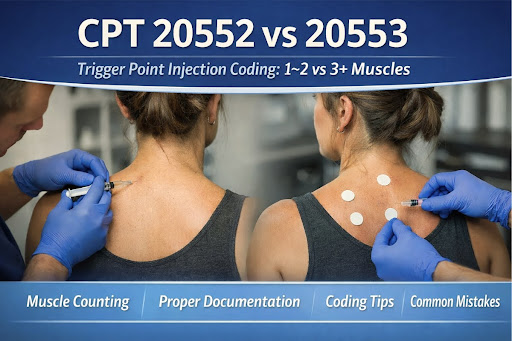
CPT 20552 and 20553 report trigger point injections based on the number of muscles treated, not the number of injections. Use 20552 for 1 to 2 muscles and 20553 for 3 or more muscles during the same session.
Even if multiple injections are performed within a single muscle, it still counts as one muscle. That’s why clear identification and documentation of each muscle treated is essential to ensure accurate coding, proper reimbursement, and to avoid billing errors.
This guide covers key differences between CPT 20552 and 20553, correct muscle counting, documentation and common mistakes to help ensure accurate coding and maximize reimbursement.
Trigger point injections (TPIs) are a minimally invasive procedure used to treat painful areas of muscle that contain trigger points, often described as tight knots or bands within the muscle. These trigger points can cause localized pain or refer pain to other parts of the body.
TPIs are commonly used to manage conditions such as myofascial pain syndrome, chronic neck and back pain, and fibromyalgia. The goal of the injection is to relax the affected muscle, reduce inflammation, and provide pain relief, ultimately improving mobility and function.
During the procedure, a healthcare provider inserts a small needle directly into the trigger point. The injection may contain:
A local anesthetic (such as lidocaine)
A corticosteroid to reduce inflammation
Or sometimes saline for a dry needling effect
The procedure is typically quick, performed in an outpatient setting, and requires minimal downtime, making it a widely used treatment option in pain management.
Key Differences Between CPT 20552 and 20553
Feature
CPT 20552
CPT 20553
Muscles treated
1 to 2 muscles
3 or more muscles
Basis of coding
Number of muscles, not injections
Number of muscles, not injections
Injection count relevance
Not relevant
Not relevant
Complexity level
Lower
Higher
Typical use case
Localized muscle pain
Widespread muscle pain involving multiple areas
Documentation requirement
Basic muscle identification
Detailed listing of all muscles treated
Reimbursement
Lower compared to 20553
Higher due to increased complexity
Accurate documentation of each muscle treated is essential to ensure correct code selection and prevent billing errors or claim denials.
How to Count Muscles Correctly?
Correct muscle counting is the most important factor in selecting between CPT 20552 and CPT 20553. The coding decision is based strictly on the number of distinct muscles treated, not the number of injections or trigger points.
Key Rules for Muscle Counting
Each muscle is counted once, regardless of how many injections are performed
Multiple trigger points within the same muscle still equal one muscle
Only distinct anatomical muscles are counted separately
Accurate documentation of each muscle is required for correct coding
Common Mistake to Avoid
Counting injections instead of muscles
Example: 5 injections in the trapezius still equal one muscle, not five
Accurate identification of each treated muscle is essential to ensure correct code selection, proper reimbursement, and to avoid claim denials.
Documentation Requirements for CPT 20552 and 20553 Coding
Accurate documentation is essential for correct CPT coding of trigger point injections and directly supports medical necessity, proper reimbursement, and compliance.
Essential Documentation Elements
Names of all muscles treated (required for correct muscle counting)
Number of trigger points injected (supporting detail, not primary coding factor)
Medication used including type, dosage, and volume
Injection technique and approach used during the procedure
Patient response to treatment, including immediate relief or tolerance
Medical Necessity Details
Clear diagnosis supporting pain and trigger point treatment
Relevant symptoms such as localized or referred muscle pain
Prior conservative treatments tried, if applicable
Procedure Note Must Include
Exact muscles injected during the session
Number of injections per muscle (for clinical detail)
Any complications or patient reactions
Post-procedure instructions provided
Why Documentation Matters
Ensures correct selection between CPT 20552 and 20553
Supports insurance reimbursement
Reduces risk of claim denials and audit issues
Provides legal and clinical proof of performed services
Audit Risks and Compliance Considerations
Trigger point injection coding is frequently reviewed by payers due to its reliance on precise documentation and muscle-based coding rules. Small errors can quickly lead to denials or audit flags.
Common Audit Triggers
Frequent reporting of CPT 20553 without clear documentation support
Documentation that does not clearly identify each muscle treated
Repeated use of the same diagnosis without clinical justification
Inconsistencies between procedure notes and billed codes
Compliance Risks
Upcoding due to incorrect muscle counting
Lack of medical necessity supporting repeated injections
Missing or incomplete procedure details in the medical record
How to Reduce Audit Risk
Ensure every treated muscle is clearly documented
Match CPT code strictly to the number of muscles injected
Use standardized templates for procedure notes
Conduct regular internal coding audits
Proper documentation and consistent coding practices are essential to stay compliant and avoid costly audit findings.
Real-World Coding Scenarios
Understanding real cases helps clarify how CPT 20552 and 20553 should be applied based on muscle count, not injection count.
Scenario 1: Localized Muscle Treatment
Trapezius muscle injected
Multiple trigger points treated within the same muscle
Correct code: CPT 20552 (1 muscle)
Scenario 2: Two-Muscle Involvement
Trapezius and levator scapulae injected
Multiple injections across both muscles
Correct code: CPT 20552 (2 muscles)
Scenario 3: Multiple Muscle Groups
Trapezius, levator scapulae, and rhomboid muscles injected
Each muscle treated separately
Correct code: CPT 20553 (3 muscles)
Scenario 4: Complex Pain Pattern
Lumbar paraspinal, gluteus medius, and quadratus lumborum muscles injected
Widespread trigger points across multiple regions
Correct code: CPT 20553 (3 or more muscles)
Even if a muscle receives multiple injections, it still counts as one muscle only, and the CPT code must reflect the total number of distinct muscles treated.
Common Coding Mistakes to Avoid
Errors in trigger point injection coding are common and can lead to claim denials, underpayment, or compliance risks. Most mistakes happen due to the following reasons:
1. Counting Injections Instead of Muscles
One of the most frequent errors
Multiple injections in a single muscle are often incorrectly counted as separate muscles
2. Incorrect Use of CPT 20552 and 20553
Reporting 20552 when 3 or more muscles were treated
Upcoding to 20553 without proper documentation
3. Incomplete Documentation
Missing names of treated muscles
Lack of clarity on number of muscles injected
Weak or missing medical necessity notes
4. Missing or Incorrect Modifiers
Failure to apply Modifier 25 when an E/M service is separately performed
Incorrect use of Modifier 59 in certain payer situations
5. Overlooking Payer Guidelines
Ignoring Medicare or commercial payer-specific rules
Not checking frequency limitations or prior authorization requirements
6. Frequency and Utilization Errors
Excessive treatment frequency beyond payer limits
Typically, no more than 3 to 4 sessions are covered in 90 days according to Medicare (Noridian) and EmblemHealth guidelines
Best Practices for Accurate CPT 20552 and 20553 Coding
Following consistent coding and documentation practices is essential to ensure accuracy, compliance, and proper reimbursement for trigger point injections.
1. Standardize Documentation
Use structured templates for trigger point injection procedures
Ensure every note clearly lists each muscle treated
Include diagnosis and medical necessity in every record
2. Train Providers and Staff
Educate clinicians on muscle counting rules
Reinforce that injections do not equal muscles
Provide coding refreshers for common error areas
3. Improve Coding Accuracy
Always verify the number of muscles before assigning CPT code
Cross-check procedure notes against billing entries
Avoid assumptions when documentation is unclear
4. Strengthen Compliance Processes
Conduct regular internal audits of TPI claims
Monitor patterns of CPT 20553 usage for accuracy
Stay updated with payer-specific billing policies
5. Reduce Denials and Improve Reimbursement
Ensure complete and precise documentation every time
Match CPT code strictly with documented muscle count
Review rejected claims for recurring documentation gaps
Learn more strategies to improve financial performance in our guide on Medical Billing Tips to Maximize Revenue for better coding accuracy and higher reimbursements.
FAQs
What is the main difference between CPT 20552 and 20553?
The difference is based on the number of muscles treated. CPT 20552 is used for 1 to 2 muscles, while CPT 20553 is used for 3 or more muscles.
Do multiple injections in one muscle change the CPT code?
No. Even if multiple injections are given in one muscle, it still counts as a single muscle for coding purposes.
Can CPT 20552 and 20553 be billed on the same day?
No. Only one code is selected per session based on the total number of muscles treated.
What documentation is required for trigger point injections?
Documentation must include the names of muscles treated, diagnosis, procedure details, medication used, and medical necessity.
Why is correct muscle counting important?
Correct muscle counting ensures accurate coding, proper reimbursement, and helps prevent claim denials and audit issues.
What happens if the wrong code is used?
Using the wrong code can lead to claim denials, underpayment, overpayment recovery, or audit risks.
Enhance Your Medical Coding Accuracy with Summit RCM
Accurate CPT 20552 and 20553 coding is essential for proper reimbursement, compliance, and reducing claim denials in trigger point injection services. Since these codes are based strictly on the number of muscles treated, precise documentation and correct muscle counting are critical to avoid errors and audit risks.
Partner with Summit RCM’s expert medical coding services to take the complexity out of CPT 20552 and 20553 coding. Our experienced coding professionals ensure accurate muscle-based reporting, complete and compliant documentation review, and precise CPT assignment to help you avoid costly errors and denials.
.png)