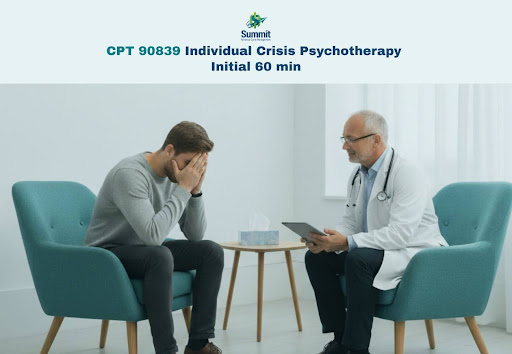
Crisis situations in behavioral health require immediate, intensive, and clinically focused intervention. When patients present with acute emotional distress, suicidal ideation, severe anxiety, or other psychiatric emergencies, providers must respond swiftly to stabilize the patient and reduce the risk of harm.
CPT 90839 appropriately reimburses providers for the urgency, time, and complexity of crisis intervention; it is also one of the most closely scrutinized psychotherapy codes. Because it reflects unscheduled, crisis-level care, payers closely examine documentation quality, time thresholds, medical necessity, and provider eligibility. Inaccurate use or insufficient documentation can quickly result in denials, audits, or payment recoupments.
This comprehensive guide breaks down CPT 90839 from a revenue cycle management perspective, covering its definition, appropriate clinical use, time and documentation requirements, billing rules, payer expectations, compliance risks, and best practices. The goal is to help behavioral health practices bill crisis psychotherapy accurately, confidently, and compliantly while minimizing financial and regulatory risk.
What Is CPT 90839?
CPT 90839 is defined as:
Psychotherapy for crisis; first 60 minutes.
This code is used when a provider delivers immediate, time-intensive psychotherapy to address an acute psychiatric crisis that places the patient or others at risk.
Key Characteristics of CPT CPT 90839
- Designed specifically for crisis situations
- Time-based code for the first 60 minutes
- Requires urgent assessment and intervention
- Focuses on stabilization and safety
- Does not include Evaluation and Management (E/M) services
- May be reported in conjunction with add-on code 90840 for additional time
CPT 90839 is fundamentally different from routine psychotherapy codes because it reflects unscheduled, high-intensity clinical work performed under urgent circumstances.
What Qualifies as a Psychiatric Crisis?
A psychiatric crisis is a situation in which a patient experiences a sudden escalation of symptoms that require immediate intervention to prevent serious harm.
Examples of Crisis Situations
- Suicidal ideation with intent or plan
- Acute homicidal ideation
- Severe panic attacks causing functional impairment
- Psychotic episodes with loss of reality testing
- Emotional dysregulation following trauma
- Extreme agitation or distress requiring immediate stabilization
- Risk of self-harm or harm to others
The defining feature of a crisis is immediacy and severity, not diagnosis alone. A patient with a chronic mental health condition may experience a crisis, while another patient with the same diagnosis may not.
Who Can Bill CPT 90839?
CPT 90839 may be billed by licensed mental health professionals who are authorized to provide psychotherapy services under payer and state regulations.
Common Eligible Providers
- Psychiatrists
- Psychologists
- Licensed Clinical Social Workers (LCSWs)
- Licensed Professional Counselors (LPCs)
- Marriage and Family Therapists (MFTs)
- Psychiatric Nurse Practitioners (depending on payer policy)
Providers must be practicing within their scope of licensure and credentialed with the payer. Unlike CPT 90838, CPT 90839 does not require a medical provider, as it does not include E/M services.
CPT 90839 Time Requirements and Documentation Guidelines
Time is a central component of CPT 90839 and one of the most common sources of billing errors.
Minimum Time Threshold
CPT 90839 represents the first 60 minutes of crisis psychotherapy and may be billed when at least 30 minutes of crisis intervention is provided.
This is a critical distinction. While the code descriptor states “first 60 minutes,” CPT guidelines allow reporting when 30–74 minutes of crisis psychotherapy is furnished.
What Counts as Crisis Psychotherapy Time?
Crisis psychotherapy time includes:
- Face-to-face therapeutic interaction
- Immediate assessment of risk
- Crisis stabilization techniques
- Safety planning
- De-escalation strategies
- Emotional support focused on resolving the crisis
Time spent must be directly related to managing the crisis.
What Does Not Count?
The following do not count toward crisis psychotherapy time:
- Administrative tasks
- Routine documentation completed outside the session
- Scheduling or billing activities
- Non-therapeutic conversations
- Time spent when the patient is not present
Accurate time documentation is essential to justify CPT 90839.
How and When to Use CPT 90840 for Extended Crisis Sessions
When crisis psychotherapy extends beyond the initial 60 minutes, providers may bill CPT 90840.
CPT 90840 Overview
- Add-on code for each additional 30 minutes
- Must be billed with CPT 90839
- Requires documentation of additional crisis intervention time
There is no explicit maximum number of 90840 units defined in CPT guidelines, but excessive billing may trigger audits. Documentation must clearly justify continued crisis-level care.
Documentation Requirements for CPT 90839
Because CPT 90839 is high-risk and high-intensity, documentation must be thorough, specific, and clinically sound.
Required Documentation Elements
To support CPT 90839, documentation should include:
- Clear description of the crisis situation
- Immediate risk assessment
- Clinical rationale for crisis-level intervention
- Start and stop times or total time spent
- Interventions used to stabilize the patient
- Patient response to interventions
- Safety planning and next steps
- Disposition of the patient following the session
Importance of Medical Necessity
Documentation must clearly establish why the encounter qualified as a crisis rather than routine psychotherapy. Generic or vague language is insufficient and frequently leads to denials.
CPT 90839 vs. Standard Psychotherapy Codes
Understanding when not to use CPT 90839 is just as important as knowing when to use it.
Key Differences
| Feature |
CPT 90839 |
Standard Psychotherapy |
| Purpose |
Crisis intervention |
Routine therapy |
| Urgency |
Immediate |
Scheduled |
| Time Threshold |
30+ minutes |
16, 38, or 53 minutes |
| Risk Level |
High |
Variable |
| Audit Risk |
High |
Moderate |
CPT 90839 should never be used for routine psychotherapy, even if the session is emotionally intense.
Billing Rules and Restrictions
Same-Day Billing
CPT 90839 may be billed on the same day as other services only when payer rules allow and documentation clearly supports separate and distinct services.
Telehealth Billing
Many payers allow CPT 90839 to be billed via telehealth when:
- Real-time interactive communication is used
- The crisis intervention is clinically appropriate
- Telehealth modifiers and place of service codes are applied correctly
Payer-specific policies must always be verified.
Common Denial Reasons for CPT 90839
CPT 90839 is frequently denied due to avoidable issues, including:
- Insufficient documentation of a true crisis
- Failure to meet minimum time requirements
- Lack of risk assessment
- Vague or generic progress notes
- Inappropriate provider type
- Billing crisis codes too frequently for the same patient
Because payers analyze billing patterns, repeated misuse increases audit exposure.
Strategies to Reduce Denials and Audit Risk
Effective Revenue Cycle Management strategies include:
- Provider education on crisis code criteria
- Clear internal definitions of what constitutes a crisis
- Standardized crisis documentation templates
- Pre-billing review of crisis claims
- Regular audits of high-risk codes
- Monitoring frequency of 90839 usage by provider
Proactive compliance efforts significantly reduce recoupment risk.
Many claim denials are avoidable and often result from common billing errors, as discussed in Mistakes Leading to Claim Denials in Medical Billing.
Role of Diagnosis Coding (ICD-10)
Diagnosis codes must support the severity and urgency of crisis intervention.
Best Practices for ICD-10 Coding
- Use diagnoses that reflect acute symptoms
- Ensure alignment between diagnosis, symptoms, and intervention
- Avoid vague or outdated diagnoses
- Update diagnoses as clinical status changes
Diagnosis coding should clearly reinforce the medical necessity for crisis-level care.
Compliance and Regulatory Considerations
CPT 90839 must comply with:
- CPT time and service definitions
- Payer-specific coverage policies
- State licensure and scope-of-practice rules
- Documentation standards for medical necessity
Improper use can result in:
- Claim denials
- Payment recoupments
- Pre- and post-payment audits
- Compliance investigations
- Reputational harm
Strong compliance oversight is essential for practices that bill crisis psychotherapy regularly.
Best Practices for Revenue Cycle Management
For Providers
- Use CPT 90839 only when true crisis criteria are met
- Document risk and urgency clearly
- Track time accurately
- Avoid routine use of crisis codes
For Billing Teams
- Verify payer coverage rules
- Review crisis documentation prior to submission
- Monitor denial trends
- Flag high-frequency usage patterns
For Practice Leadership
- Implement compliance training
- Conduct regular internal audits
- Establish clear crisis billing policies
- Partner with specialized RCM experts
Many revenue challenges can be prevented with proactive billing practices, which are detailed in Proactive Medical Billing: Expert Tips to Maximize Your Revenue.
Future Trends Impacting CPT 90839
The behavioral health billing landscape continues to evolve, with trends that directly impact crisis psychotherapy billing:
- Increased use of AI-driven payer audits
- Expanded telehealth utilization
- Greater scrutiny of high-acuity codes
- Stronger emphasis on documentation quality
- Shift toward value-based behavioral health care
Practices that adapt early will be better positioned to maintain revenue stability and compliance.
Summit RCM Supports Compliant CPT 90839 Billing
CPT 90839 plays a vital role in reimbursing providers for life-stabilizing crisis interventions. When used appropriately, it reflects the urgency, complexity, and intensity of care required during psychiatric emergencies.
However, because of its high audit risk, successful use of CPT 90839 depends on accurate time tracking, strong documentation, clear medical necessity, and disciplined revenue cycle management processes.
At Summit RCM, we help behavioral health practices manage high risk codes like CPT 90839 with confidence through expert Medical Coding Services, proactive compliance strategies, and specialized revenue cycle management solutions.
Crisis encounters often involve rapid decision making and immediate documentation demands, leaving little room for administrative error. Through our Virtual Medical Assistant Services, practices gain structured operational support that reinforces scheduling accuracy, documentation coordination, insurance verification, and claim follow up. This integrated approach strengthens workflow reliability during high intensity situations, ensuring that critical services are properly recorded and submitted without compromising compliance.
.png)