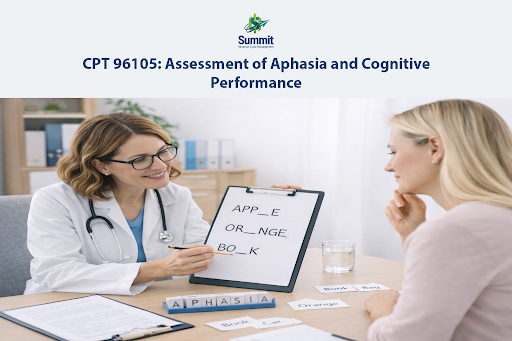
CPT Code 96105 represents a structured clinical evaluation focused on assessing aphasia and cognitive performance. This service is typically conducted by qualified healthcare professionals, including speech-language pathologists, neuropsychologists, and other trained clinicians with expertise in neurological communication disorders. The assessment systematically evaluates language abilities alongside related cognitive functions such as memory, attention, and executive processing.
The purpose of this evaluation is to identify the type and severity of impairment, differentiate language disorders from other neurological conditions, and develop a clear, individualized treatment strategy.
This comprehensive guide explains what aphasia is, what cognitive performance assessment involves, how evaluations are conducted, what tools are used, and why early assessment is critical for rehabilitation.
Table of Contents
Table of Contents
What Is Aphasia?
Aphasia is a language disorder caused by damage to areas of the brain responsible for language processing. It most commonly occurs after:
- Stroke
- Traumatic brain injury
- Brain tumors
- Infections
- Neurodegenerative diseases
Aphasia does not affect intelligence. Instead, it disrupts the ability to use or understand language.
Common Symptoms of Aphasia
- Difficulty speaking fluently
- Trouble finding words
- Incomplete sentences
- Substituting incorrect words
- Difficulty understanding spoken language
- Problems reading or writing
The severity can range from mild word-finding issues to severe communication impairment.
What Are the Different Types of Aphasia?
Understanding the type of aphasia helps guide assessment and treatment.
1. Broca’s Aphasia (Non-Fluent Aphasia)
- Speech is effortful and broken
- Short phrases
- Comprehension relatively preserved
2. Wernicke’s Aphasia (Fluent Aphasia)
- Speech flows easily but lacks meaning
- Poor comprehension
- Unaware of errors
3. Global Aphasia
- Severe impairment in both speaking and understanding
4. Anomic Aphasia
- Primary difficulty with word retrieval
Each type presents differently and requires careful assessment to distinguish.
Language does not function in isolation. It relies heavily on cognitive systems such as:
- Attention
- Memory
- Executive function
- Processing speed
- Problem solving
- Visual-spatial skills
A comprehensive evaluation examines these areas because cognitive impairments often coexist with aphasia, especially after neurological injury.
Cognitive testing helps determine:
- Whether memory difficulties are contributing to communication problems
- If attention deficits interfere with conversation
- Whether executive dysfunction affects problem-solving in daily life
Why Code 96105 Matters
96105 represents a structured, professional evaluation process. It is not a casual screening. It involves:
- Standardized testing
- Clinical observation
- Structured tasks
- Functional communication assessment
- Detailed scoring and interpretation
This code is typically used when a clinician performs a formal assessment of language and cognitive performance, often following neurological injury.
Who Conducts the Assessment?
Assessments are typically performed by:
- Speech-Language Pathologists (SLPs)
- Neuropsychologists
- Clinical psychologists
- Rehabilitation specialists
The professional conducting the evaluation must be trained in standardized testing and interpretation of neurological communication disorders.
What Are the Key Components of an Aphasia Assessment?
A thorough aphasia evaluation may include the following domains:
1. Expressive Language
- Naming objects
- Describing pictures
- Conversational speech
- Sentence construction
2. Receptive Language
- Following directions
- Answering yes/no questions
- Comprehending spoken sentences
3. Reading and Writing
- Reading comprehension
- Writing sentences
- Copying text
- Spelling
4. Pragmatic Communication
- Turn-taking
- Topic maintenance
- Social communication skills
Formal evaluation of aphasia relies on standardized, evidence-based instruments that measure different aspects of language performance. These tools help clinicians determine the type, severity, and pattern of impairment while ensuring reliable and objective results.
Boston Diagnostic Aphasia Examination (BDAE)
A comprehensive assessment that evaluates speech production, auditory comprehension, reading, writing, and naming abilities. It is widely used to classify aphasia types and identify specific language deficits.
Western Aphasia Battery (WAB)
Designed to determine the presence, type, and severity of aphasia. It provides an Aphasia Quotient (AQ) score, which helps quantify overall language impairment.
Aphasia Diagnostic Profiles (ADP)
Focuses on identifying patterns of language strengths and weaknesses. It supports detailed profiling of expressive and receptive language abilities.
Quick Aphasia Battery (QAB)
A shorter, structured tool used for rapid screening and severity estimation. It is particularly useful in acute clinical settings.
Each of these instruments generates standardized scores that assist clinicians in accurately diagnosing aphasia, guiding treatment planning, and monitoring recovery over time.
When cognitive performance is assessed, clinicians may evaluate:
Attention
- Sustained attention
- Divided attention
Memory
- Short-term memory
- Working memory
- Delayed recall
Executive Function
- Planning
- Organizing
- Abstract reasoning
Processing Speed
- Speed of response
- Reaction time
Visual-Spatial Skills
- Pattern recognition
- Object placement
Standard tools may include:
- Montreal Cognitive Assessment (MoCA)
- Mini-Mental State Examination (MMSE)
- Trail Making Test
- Digit Span tasks
How the Assessment Is Conducted and What It Involves
A thorough evaluation follows a structured yet individualized approach, combining clinical interview, standardized testing, and functional observation to gain a comprehensive understanding of language and cognitive abilities.
Step 1: Clinical Interview
The assessment begins with a detailed clinical interview. The clinician gathers important background information, including medical history, the onset and progression of symptoms, educational and occupational background, and current communication challenges in daily life. This step provides context for understanding how language and cognitive difficulties affect the individual’s functioning.
Step 2: Standardized Testing
Next, structured and validated assessment tools are administered under controlled conditions. These tests evaluate various aspects of language and cognition, such as speaking, comprehension, memory, attention, and executive functioning. Standardized measures ensure accuracy, reliability, and objective scoring.
Step 3: Functional Communication Assessment
Beyond formal testing, the clinician observes how the individual communicates in practical, real-world situations. This may include conversational speech, task-based interactions, or problem-solving scenarios. Functional assessment helps determine how impairments impact everyday activities.
Step 4: Interpretation and Comprehensive Report
Finally, the clinician analyzes the results and prepares a detailed report. This includes a diagnosis (if applicable), severity classification, identification of strengths and areas of difficulty, and personalized treatment recommendations. The report serves as a roadmap for rehabilitation and ongoing care.
How Does Early Assessment Improve Recovery Outcomes?
Early evaluation provides several advantages:
- Identifies deficits promptly
- Guides targeted therapy
- Prevents secondary complications
- Improves rehabilitation outcomes
Neuroplasticity is strongest in the early months after brain injury. Timely intervention maximizes recovery potential.
Differentiating Aphasia from Other Conditions
A comprehensive assessment is essential to accurately distinguish aphasia from other disorders that may present with similar symptoms. These may include:
- Dysarthria, a motor speech disorder affecting speech clarity
- Apraxia of speech, a condition impacting speech motor planning
- Dementia, which involves progressive cognitive decline
- Delirium, characterized by sudden confusion and altered awareness
- Hearing impairment, which can mimic language comprehension difficulties
Accurate diagnosis ensures that individuals receive appropriate, condition-specific treatment rather than interventions that may not address the root cause of symptoms.
Emotional and Psychological Impact
Aphasia affects more than language. It can lead to:
- Frustration
- Social withdrawal
- Depression
- Anxiety
Cognitive and emotional screening helps ensure holistic care.
Cultural and Linguistic Considerations
Assessment must consider:
- Primary language
- Cultural background
- Education level
Using culturally appropriate tools ensures accurate results.
How Results Guide Treatment
The findings from an aphasia and cognitive evaluation provide a clear framework for individualized care. By identifying specific strengths and areas of difficulty, clinicians can design targeted interventions that address each person’s unique needs.
Assessment results help guide:
- Speech therapy goals, tailored to improve expressive and receptive language skills
- Cognitive rehabilitation strategies, focused on attention, memory, and executive functioning
- Compensatory techniques, such as communication strategies that support daily functioning
- Caregiver education, equipping family members with tools to facilitate effective communication
Based on the evaluation, treatment may include structured word-retrieval exercises, memory enhancement techniques, use of communication aids (such as picture boards or speech-generating devices), and technology-assisted therapy programs. These interventions are selected to maximize independence, restore confidence, and improve overall quality of life.
How Progress Is Monitored Over Time
Recovery from aphasia and cognitive impairment is not static; it evolves over time. Repeat assessments play a critical role in tracking improvement and identifying areas that may require further intervention. Through periodic re-evaluation, clinicians can monitor the recovery trajectory, measure therapy effectiveness, and determine whether treatment strategies need adjustment.
Objective data gathered from follow-up assessments supports evidence-based clinical decision-making. This ensures that therapy remains targeted, responsive, and aligned with the individual’s progress and changing needs.
Why Family Support Matters in Rehabilitation
Family members are essential partners in the rehabilitation process. Because communication challenges affect daily interactions, caregivers often provide ongoing support outside of therapy sessions.
Assessment results help families better understand the nature and severity of the condition. With proper guidance, caregivers can adjust their communication style, create supportive environments, and encourage consistent daily practice. Active family involvement enhances motivation, reinforces therapeutic gains, and promotes long-term improvement.
Technological Advances in Assessment
Technological innovation has significantly enhanced the way aphasia and cognitive evaluations are conducted. Modern assessment approaches now integrate digital tools that improve precision, accessibility, and efficiency.
Contemporary evaluations may include:
- Computer-based cognitive testing for structured and automated assessment of memory, attention, and executive function
- Tablet-based language tasks that allow interactive and engaging evaluation of speech and comprehension skills
- Telehealth assessments, enabling remote evaluation for individuals in rural or underserved areas
- AI-supported scoring systems that enhance accuracy, reduce human error, and provide detailed performance analytics
These technological tools offer several advantages:
- Improved accessibility to specialized services
- Faster and more standardized scoring
- Enhanced data tracking over time
- Greater flexibility in monitoring progress
By incorporating digital advancements, clinicians can deliver more responsive, data-driven, and patient-centered care.
Ethical and Professional Considerations
Aphasia and cognitive assessments must be conducted with strict adherence to ethical and professional standards. These evaluations involve sensitive personal and medical information, making integrity and clinical responsibility essential throughout the process.
Every assessment should ensure:
- Informed consent, where individuals (or their legal representatives) clearly understand the purpose, procedures, and potential outcomes of the evaluation
- Confidentiality, safeguarding personal health information in accordance with legal and ethical guidelines
- Standardized administration, ensuring tests are conducted consistently to maintain reliability and validity
- Cultural and linguistic fairness, taking into account language background, education level, and cultural context to prevent bias
Accurate interpretation by a qualified professional is critical. Misinterpretation of results can lead to incorrect diagnoses or inappropriate treatment plans. Ethical practice not only protects the individual’s rights but also ensures that assessment findings truly reflect their abilities and needs.
To better understand how outsourcing can streamline operations and improve collections, read our article on the Benefits of Hiring a Medical Billing Company.
Why a Multidisciplinary Approach Matters in Rehabilitation
Successful rehabilitation rarely depends on a single form of therapy. Instead, it often requires a coordinated, multidisciplinary approach that addresses communication, cognition, emotional wellbeing, and daily functioning.
Effective rehabilitation may involve:
- Speech therapy, focused on improving expressive and receptive language skills
- Cognitive therapy, targeting attention, memory, and executive functioning
- Occupational therapy, supporting independence in daily living activities
- Psychological support, addressing emotional adjustment, stress, and mental health concerns
When healthcare professionals collaborate across disciplines, treatment becomes more holistic and personalized. Interdisciplinary care ensures that all aspects of recovery are addressed, leading to more meaningful and sustainable outcomes.
What Influences Long-Term Recovery?
The long-term outlook for individuals with aphasia or cognitive impairment varies widely. Recovery is influenced by several important factors, including:
- Severity of the condition
- Underlying cause (such as stroke, trauma, or neurological disease)
- Age of the individual
- Timing of intervention
- Strength of the support system
Although outcomes differ from person to person, many individuals regain significant communication abilities with:
- Early and consistent intervention
- Structured and goal-oriented therapy
- Active family involvement
- Ongoing practice and reinforcement
With appropriate care, coordinated support, and sustained effort, individuals can make meaningful progress and experience improved quality of life.
For more strategies on improving reimbursement accuracy and optimizing your practice’s financial performance, explore our detailed guide on Medical Billing Tips to Maximize Your Revenue.
Summit RCM Supports Clinical Excellence Through Operational Precision
At Summit RCM, we understand that accurate assessment is the cornerstone of effective care. Proper documentation, precise coding, and thorough evaluation processes are essential to ensuring patients receive the support and rehabilitation services they need. By streamlining clinical workflows and supporting healthcare providers with reliable administrative solutions, we help practices focus on what matters most, patient recovery and quality outcomes.
Through our specialized Virtual Medical Assistant Services, Summit RCM supports healthcare teams in managing documentation, scheduling, medical billing, and coordination tasks with efficiency and accuracy. Our goal is to reduce administrative burden, enhance compliance, and enable providers to dedicate more time to delivering compassionate, patient-centered care.
With the right clinical assessment and strong operational support, healthcare organizations can improve both patient outcomes and practice performance. Summit RCM is committed to being a trusted partner in that journey.
.png)