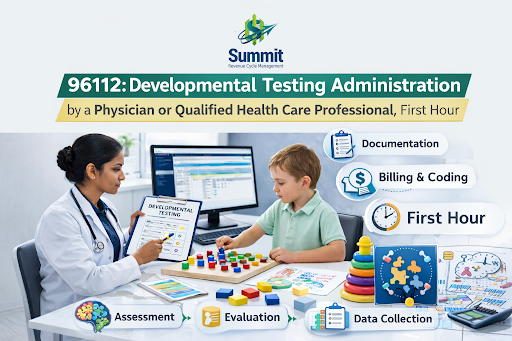
CPT code 96112 represents a critical service within pediatric and developmental healthcare. It covers the administration of comprehensive developmental testing by a physician or qualified healthcare professional during the first hour of direct evaluation. This code reflects not only the time spent conducting standardized assessments but also the professional interpretation and clinical analysis required to guide care decisions.
Accurately applying CPT 96112 is essential to maintaining both clinical excellence and financial stability within a practice. Proper use of the code supports precise documentation, strengthens regulatory compliance, and ensures appropriate reimbursement for the services provided.
This comprehensive guide outlines what CPT 96112 includes, when it should be billed, documentation standards, common coding pitfalls, and proven strategies to support compliant billing and revenue optimization.
Table of Contents
Table of Contents
What Is CPT Code 96112?
CPT code 96112 is defined as:
“Developmental test administration (including assessment of fine and gross motor, language, cognitive level, social, memory and/or executive functions by standardized developmental instruments when performed), by physician or other qualified health care professional, first hour.”
This code covers:
- Administration of standardized developmental testing
- Direct interaction with the patient
- Clinical scoring and interpretation
- Documentation of findings
- First hour of service
If testing exceeds one hour, CPT code 96113 is used for each additional 30 minutes.
Why Is Developmental Testing Conducted?
Developmental testing is performed to evaluate a child’s progress across multiple domains of functioning. It helps providers:
- Identify developmental delays
- Assess intellectual functioning
- Evaluate behavioral concerns
- Monitor autism spectrum disorder symptoms
- Measure language and motor skills
- Track treatment progress
This testing is often recommended when concerns arise during routine screenings, school reports, parental observations, or behavioral evaluations.
Who Can Bill CPT 96112?
CPT 96112 may be billed by:
- Physicians (e.g., pediatricians, developmental pediatricians, neurologists)
- Clinical psychologists
- Neuropsychologists
- Other qualified healthcare professionals acting within scope of practice
The service must be performed and interpreted by a licensed provider qualified to administer standardized developmental tests.
It cannot be billed by:
- Medical assistants
- Non-licensed staff
- Technicians without supervision
When Is CPT 96112 Appropriate?
CPT 96112 is typically used when:
- A child shows signs of developmental delay
- Autism evaluation is being conducted
- ADHD is suspected
- Learning disabilities are being assessed
- Behavioral concerns require structured evaluation
- Intellectual disability needs formal assessment
- Neurodevelopmental disorders require monitoring
It is important to distinguish CPT 96112 from general screening tools. Brief developmental screenings conducted during well-child visits are usually billed under different codes.
What is the Difference Between Screening and Testing?
Developmental screening:
- Short
- Questionnaire-based
- Used for early identification
- Often billed using CPT 96110
Developmental testing (CPT 96112):
- Standardized and structured
- Comprehensive assessment
- Requires scoring and interpretation
- Time-based billing
This distinction is crucial for compliance and reimbursement.
What Does the First Hour Include?
CPT 96112 covers the first 60 minutes of:
- Direct face-to-face testing
- Administration of standardized tools
- Scoring and interpretation
- Documentation
- Clinical analysis
Time must be documented clearly.
If testing extends beyond 60 minutes:
- Use CPT 96113 for each additional 30 minutes
Providers may use standardized instruments such as:
- Bayley Scales of Infant and Toddler Development
- Wechsler Intelligence Scale for Children (WISC)
- Vineland Adaptive Behavior Scales
- Autism Diagnostic Observation Schedule (ADOS)
- Stanford-Binet Intelligence Scales
- NEPSY Neuropsychological Assessment
- Developmental Assessment of Young Children (DAYC)
The choice of tool depends on age, presenting concern, and clinical objectives.
Documentation Requirements
Accurate documentation is essential for compliance and reimbursement.
Your documentation should include:
- Reason for referral
- Clinical indication for testing
- Type of standardized instrument used
- Total time spent
- Observations during testing
- Scoring results
- Interpretation of findings
- Clinical impression
- Recommendations
Time documentation must be clear and specific.
Example:
“Total developmental testing time: 75 minutes. First 60 minutes billed under 96112. Additional 15 minutes included in 96113.”
Time-Based Billing Rules
CPT 96112 follows time-based billing guidelines:
- Must meet minimum time requirement
- More than half of the stated time must be completed
- First hour billed under 96112
- Additional time billed under 96113 (in 30-minute increments)
Incomplete time cannot be rounded improperly.
Reimbursement Considerations
Reimbursement for CPT 96112 varies based on:
- Payer policies
- Geographic location
- Provider credentials
- Documentation quality
- Medical necessity
Some payers require:
- Prior authorization
- Specific diagnosis codes
- Supporting clinical notes
Always verify payer-specific guidelines.
Medical Necessity Requirements
To justify CPT 96112, documentation must clearly establish medical necessity.
Examples include:
- Developmental delay
- Autism spectrum disorder
- ADHD
- Intellectual disability
- Speech and language disorder
- Traumatic brain injury
- Genetic conditions affecting development
Routine academic testing without medical indication may not qualify.
Common Billing Errors to Avoid
Billing 96112 for brief screening tools
Failing to document time accurately
Not documenting standardized test names
Lack of interpretation in notes
Billing without clear medical necessity
Not using 96113 when additional time applies
Billing technician-administered testing under 96112
Avoiding these errors reduces claim denials and audit risk.
How CPT 96112 Compares to Other Testing Codes
It is essential to clearly differentiate CPT 96112 from other psychological and neuropsychological testing codes to ensure accurate billing and compliance.
96112 – Developmental testing administration by a physician or qualified healthcare professional, first hour
96113 – Each additional 30 minutes of developmental testing
96136 – Psychological or neuropsychological test administration by a technician
96132 – Neuropsychological testing evaluation services (interpretation and reporting)
Using the incorrect code can lead to reimbursement delays, claim denials, or compliance concerns. Proper code selection depends on who administers the test, the type of evaluation performed, and the time spent providing the service.
Role of CPT 96112 in Autism Evaluation
CPT 96112 is frequently utilized during autism spectrum disorder evaluations because standardized developmental testing is essential for diagnostic accuracy. Structured assessments provide objective data that supports clinical decision-making.
Developmental testing in autism evaluations may assess:
- Social interaction patterns
- Communication abilities
- Cognitive functioning
- Adaptive behavior skills
Comprehensive developmental evaluation is often part of a multidisciplinary diagnostic process involving pediatricians, psychologists, speech therapists, and other specialists. Accurate testing ensures a well-supported diagnosis and appropriate intervention planning.
Why Developmental Testing Is Essential for Early Intervention
Early intervention is strongly associated with improved developmental outcomes. Structured developmental testing plays a crucial role in identifying delays and initiating timely treatment.
Accurate developmental assessment helps:
- Detect delays at the earliest stage
- Enable targeted and individualized therapy
- Support educational planning and school accommodations
- Guide long-term treatment strategies
- Provide measurable benchmarks for monitoring progress
Timely and appropriate use of CPT 96112 contributes directly to better patient outcomes and improved developmental trajectories.
Telehealth Considerations for Developmental Testing
In certain cases, developmental testing may be conducted via telehealth, provided that payer guidelines and test validity standards are met. However, careful consideration is necessary to ensure compliance and clinical integrity.
Key factors include:
- Validation of the assessment tool for remote administration
- Use of HIPAA-compliant telehealth platforms
- Clear and detailed documentation
- Adherence to payer-specific telehealth policies
Before billing for telehealth-based developmental testing, providers should verify coverage requirements and reimbursement guidelines with the payer.
Revenue Cycle Management Best Practices
To optimize reimbursement for CPT 96112 services, practices should implement strong revenue cycle management protocols.
Best practices include:
- Verifying patient eligibility prior to the appointment
- Confirming authorization requirements
- Ensuring thorough and accurate documentation
- Submitting claims promptly and correctly
- Attaching required supporting documentation
- Tracking and analyzing claim denials
- Filing timely appeals when necessary
A well-managed revenue cycle supports financial stability and reduces unnecessary revenue loss.
How Can Practices Ensure Compliance and Audit Readiness?
Developmental testing services are subject to payer audits. Maintaining compliance is essential to protect against recoupments and penalties.
To ensure audit readiness:
- Maintain comprehensive clinical documentation
- Retain scoring sheets and standardized test results
- Clearly document medical necessity
- Follow time-based billing requirements accurately
- Apply appropriate modifiers when required
Consistent documentation and adherence to coding guidelines protect both providers and patients.
For actionable strategies to strengthen your collections and reduce claim denials, explore our guide on Medical Billing Tips to Maximize Your Revenue.
How Does Developmental Testing Integrate With Comprehensive Care?
Developmental testing does not function in isolation. It often serves as a foundational element within a broader treatment plan that may include:
- Speech therapy
- Occupational therapy
- Behavioral therapy
- Psychological counseling
- Educational interventions
An interdisciplinary approach ensures that communication, cognitive development, emotional wellbeing, and functional skills are addressed collectively, resulting in more meaningful and sustainable improvements.
How Developmental Testing Shapes Long-Term Outcomes
Accurate and timely developmental testing has lasting benefits beyond the initial evaluation. It supports:
- Early and precise diagnosis
- Individualized treatment planning
- Insurance authorization for therapeutic services
- Educational accommodations and support plans
- Ongoing monitoring of developmental progress
- Improved long-term independence and quality of life
Developmental testing is not merely a billing procedure; it is a critical component of pediatric healthcare and long-term developmental support.
How Administrative Support Improves Efficiency
Practices that frequently provide developmental testing services benefit significantly from structured administrative processes. Effective operational support may include:
- Pre-authorization management
- Coding accuracy reviews
- Timely and accurate claims submission
- Denial management and follow-up
- Ongoing compliance monitoring
Strong administrative systems reduce revenue leakage, streamline workflows, and allow providers to focus on delivering high-quality patient care.
If you're exploring ways to improve efficiency and financial performance, our article on How Medical Billing Services Can Transform a Small Practice offers valuable insights into optimizing your revenue cycle.
Summit RCM: Support Developmental Care Through Operational Excellence
CPT 96112 plays a critical role in developmental and pediatric healthcare. It supports structured, standardized evaluation of cognitive and developmental functioning and provides measurable insights that guide treatment and intervention.
At Summit RCM, we understand the balance between clinical excellence and operational efficiency. Our team supports healthcare practices with precise coding review, documentation oversight, denial management, and streamlined billing workflows. Through our specialized Virtual Medical Assistant Services, we help providers manage administrative responsibilities efficiently, allowing them to focus on delivering high-quality, patient-centered care.
With the right clinical processes and strong revenue cycle support, practices can enhance both patient outcomes and financial performance. Summit RCM is committed to being a trusted partner in achieving compliant, efficient, and sustainable healthcare operations.
.png)