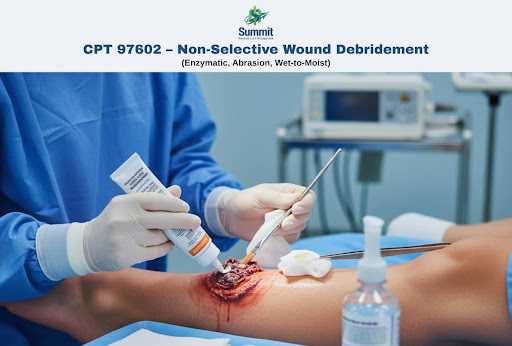
CPT 97602, the code for non-selective wound debridement, applies to a specific set of techniques such as wet-to-moist dressings, enzymatic agents, gentle abrasion, whirlpool therapy, and other non-selective approaches. This code is used per session and includes applying topical agents, assessing the wound, and providing instructions for ongoing care. It does not require anesthesia.
Because this code represents a broad yet precise category of services, understanding when and how to use it is vital for clinicians, coders, and billers.
This article outlines what CPT 97602 includes, how to document it, and when to use it to ensure accurate billing and effective wound care.
Understanding CPT Code 97602
CPT 97602 describes non-selective wound debridement, a process that removes devitalized tissue using broad, non-targeted techniques. This code applies when the provider uses methods such as enzymatic agents, gentle abrasion, wet-to-moist dressings, irrigation, or hydrotherapy to clean the wound and promote healing.
Non-selective debridement does not involve sharp instruments or surgical excision, and it generally requires minimal instrumentation. Importantly, anesthesia is not included in this code. If anesthesia is required for the procedure, it must be billed separately using the appropriate anesthesia CPT code.
This code is commonly used for chronic wounds, pressure ulcers, and other wounds containing slough or loosely adherent necrotic tissue where non-selective removal is medically appropriate.
Techniques Included Under CPT 97602
CPT 97602 covers several non-selective methods used to remove loose, non-viable tissue and maintain a healthy wound environment. These techniques do not distinguish between specific tissue types, making them appropriate for wounds with slough, necrotic debris, or biofilm that require gentle, broad debridement. The most common non-selective techniques include:
Wet-to-Moist Dressings
A mechanical method where dressings are applied moist and partially dry before removal, allowing devitalized tissue to lift away naturally.
Enzymatic Debridement
Topical agents such as collagenase chemically break down necrotic tissue without sharp instruments.
Gentle Abrasion or Irrigation
Brushing, scrubbing, or low-pressure irrigation helps loosen and remove slough or surface debris.
Whirlpool Therapy (Hydrotherapy)
Agitated water softens and removes non-viable tissue, especially useful for large or contaminated wounds.
Important Billing Note
Anesthesia is not included in CPT 97602.
If anesthesia is required, it must be billed separately using the appropriate anesthesia CPT code.
Documentation Requirements for Reporting CPT 97602
Accurate documentation is essential when reporting CPT 97602 to demonstrate medical necessity and support reimbursement. Providers must clearly describe the wound, the non-selective method used, and the clinical need for debridement.
Key Documentation Elements
- Wound Characteristics: Size, depth, location, drainage, tissue type (e.g., slough, necrosis, biofilm).
- Technique Used: Specify whether the method was enzymatic, wet-to-moist, gentle abrasion, irrigation, or hydrotherapy.
- Extent of Debridement: Description of removal of non-viable tissue and the wound's response.
- Clinical Justification: Reason the wound required non-selective debridement instead of selective or surgical methods.
- Dressing Applied: Type of dressing placed after the procedure.
- Patient Tolerance: Whether the patient tolerated the procedure well, including any pain considerations.
- Comparison Over Time: Regular updates showing wound progress to justify ongoing debridement.
When Not to Use CPT 97602
CPT 97602 should only be used when non-selective debridement methods are performed. It is not appropriate for procedures that involve targeted tissue removal, surgical techniques, or routine wound care. Use the following guidelines to avoid incorrect billing:
Use an Alternative Code Instead When:
Selective debridement is performed
The provider removes specific non-viable tissue using sharp instruments.
Bill: CPT 97597/97598
Surgical debridement is performed
The provider excises tissue down to subcutaneous tissue, muscle, or bone.
Bill: CPT 11042–11047
Care is routine and does not involve active debridement
Nursing staff performing basic cleaning, dressing changes, or monitoring does not meet the criteria for 97602.
The wound requires excision of deeper structures
If the procedure involves the removal of muscle, fascia, or bone, non-selective codes do not apply.
Bill: Surgical debridement codes instead.
Proper code selection ensures accurate billing and prevents denials related to incorrect procedure classification.
Modifier Usage for CPT 97602
Modifiers help identify the specific location and circumstances of the non-selective debridement, ensuring accurate billing when multiple wounds or sessions are involved. Correct modifier application reduces claim denials and improves reimbursement. The following modifiers are commonly used with CPT 97602:
| Modifier Type |
Code |
Description |
Usage |
| Anatomical |
LT / RT |
Left / Right side |
Use based on the wound’s anatomical location. |
| Finger |
F1–F9 / FA |
Specific finger location |
Apply when the wound is located on a finger. |
| Toe |
T1–T9 / TA |
Specific toe location |
Apply when the wound is located on a toe. |
| Procedural |
59 |
Distinct procedural service |
Use when multiple non-selective debridements are performed on the same day at separate sites or sessions. |
Tips for Using Modifiers Correctly
- Always document each wound separately when reporting multiple sites.
- Use modifier 59 only when services are distinct and not overlapping.
- Apply anatomical modifiers to clarify wound location and avoid bundling edits.
Clinical Scenarios Where CPT 97602 Applies
CPT 97602 is appropriate for wounds that require gentle, broad removal of devitalized tissue rather than targeted or surgical techniques. Below are common situations where non-selective debridement is medically necessary and properly billed with 97602.
Chronic Wound Management
Example: A diabetic foot ulcer with slough and loosely adherent necrotic tissue.
Best Method: Enzymatic debridement or wet-to-moist dressings to gradually lift away non-viable tissue.
Correct Billing: CPT 97602
Pressure Ulcers
Example: Stage II or III pressure ulcers containing mixed tissue or surface slough.
Billing Challenge: Determining whether the method used was selective or non-selective.
Solution: Verify the debridement technique with the provider and document the exact method (e.g., enzymatic agent, gentle abrasion).
Multiple Wound Sites
Non-selective debridement performed on several wounds during the same visit.
Billing Tip: Use anatomical modifiers (LT/RT, F-modifiers, T-modifiers) and apply modifier 59 when appropriate to identify separate sites.
Hydrotherapy or Whirlpool Debridement
Example: Larger contaminated wounds benefiting from water agitation or flushing to remove non-viable tissue.
Appropriate Use: When hydrotherapy is used to achieve non-selective removal of devitalized tissue.
Billing, Coding & Reimbursement Tips for CPT 97602
Accurate billing for CPT 97602 requires understanding payer expectations, documenting thoroughly, and applying modifiers correctly. These tips help ensure clean claims and reduce the risk of denials.
Know Payer Policies
Medicare and commercial insurers may have specific coverage rules for non-selective debridement.
Review your local Medicare Administrative Contractor (MAC) LCDs/NCDs for frequency limitations and medical necessity requirements.
Watch for Frequency Limits
Some payers restrict how often 97602 can be billed for the same wound.
Document progress and clinical need to justify repeated treatments.
Avoid Common Denials
- Insufficient documentation of the method used.
- Reporting 97602 when selective or surgical debridement was performed.
- Missing or incorrect anatomical modifiers for multiple wounds.
Use Proper ICD-10 Codes
Pair 97602 with diagnosis codes that reflect wound etiology and severity, such as:
- Diabetic ulcers
- Pressure ulcers
- Peripheral vascular disease
- Non-healing surgical wounds
Apply Modifiers Correctly
Use LT/RT, finger, toe, or 59 modifiers when needed to differentiate wound sites or distinct services.
For clear coding insights and tips, read our latest guide on the role of modifiers in wound care coding.
Case Examples
Practical examples help clarify when CPT 97602 is appropriate and when another code should be used. Below are scenarios illustrating correct and incorrect usage, along with supporting documentation.
Example of Appropriate Use
Scenario:
A patient presents with a chronic venous stasis ulcer covered in slough. The provider applies collagenase (enzymatic debridement) and performs gentle irrigation to remove loose necrotic tissue.
Correct Code: CPT 97602
Supporting Documentation Should Include:
- Wound size, depth, and appearance (e.g., "yellow slough covering 40% of wound bed")
- Enzymatic agent used (e.g., collagenase)
- Non-selective method performed (e.g., gentle irrigation)
- Wound response and dressing applied
Example of Incorrect Use
Scenario:
A provider uses sharp scissors and a scalpel to precisely remove devitalized tissue from the wound edges.
Correct Code Instead: CPT 97597 (selective debridement)
Why Not 97602:
Selective instrumentation was used to remove specific tissue types, making 97597/97598 the appropriate code.
Example of Surgical Debridement
Scenario:
A patient's wound requires removal of subcutaneous tissue and portions of necrotic fascia.
Correct Code: CPT 11042–11047 based on depth and size.
Why Not 97602:
The procedure involves excision into deeper anatomical structures, which qualifies as surgical debridement.
Best Practices for Compliance
Following established best practices helps ensure accurate use of CPT 97602, reduces claim denials, and supports high-quality wound care. Clear documentation and proper technique identification are essential for compliance. To stay compliant and bill this code correctly, providers should follow these key guidelines:
Confirm the Method of Debridement
Always verify whether the technique used is non-selective, selective, or surgical.
Clarify with the provider when documentation is vague or incomplete.
Use Consistent Wound Measurements
Document wound size, depth, and appearance at each visit.
Track progress over time to justify repeat debridements.
Provide Detailed Descriptions
Specify the exact non-selective method used, such as enzymatic application, wet-to-moist dressing removal, gentle abrasion, or hydrotherapy.
Avoid general statements like “wound care provided.”
Train Staff Regularly
Ensure nursing and clinical staff understand the difference between routine care and billable non-selective debridement.
Teach proper documentation techniques to support coding.
Review Payer-Specific Guidelines
Medicare and commercial payers may have their own rules for frequency, coverage, and medical necessity.
Staying updated on LCDs/NCDs improves billing accuracy.
Read more to learn how a wound care billing service boosts the revenue of your practice.
Partner With Summit RCM for Expert Wound Care Billing Services
CPT 97602 is essential for reporting non-selective debridement methods. Correct coding, clear documentation, and knowing when to use alternative debridement codes are key to compliance, preventing denials, and ensuring accurate reimbursement.
Practices seeking to enhance coding accuracy, minimize denials, and streamline wound care billing can benefit greatly from the expertise of Summit RCM. Our team delivers specialized wound care billing services designed to strengthen documentation, support compliance, and optimize reimbursement.
Contact Summit RCM today to elevate your wound care billing and maximize your revenue.
.png)