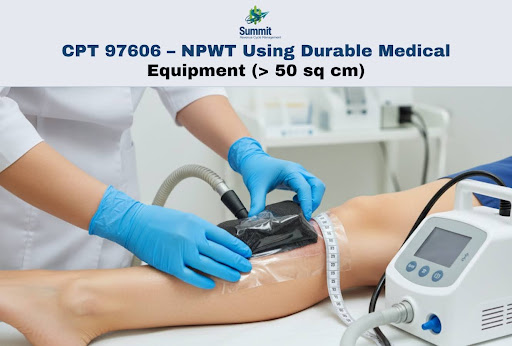
Negative Pressure Wound Therapy (NPWT) has become a critical component of modern wound care, especially for patients with large, complex, or chronic wounds that do not respond to traditional treatments. CPT 97606 is the procedural code used when NPWT is performed on wounds greater than 50 square centimeters using durable medical equipment (DME).
Understanding when and how to use CPT 97606 is essential not only for correct reimbursement but also for maintaining compliance with payer requirements.
This guide outlines CPT 97606, key documentation and coding rules, and common pitfalls to help ensure accurate and compliant wound care billing.
What Is CPT 97606?
CPT 97606 is the code used to report NPWT delivered using durable medical equipment for wounds with a total surface area greater than 50 square centimeters.
Official CPT Description
“Negative pressure wound therapy, utilizing durable medical equipment, including topical application, wound assessment, and instruction(s) for ongoing care, per session; total wound(s) surface area > 50 sq cm.”
Key Takeaways:
- CPT 97606 applies to NPWT performed with DME, not disposable systems.
- It is billed per session, not per wound.
- It applies when the combined surface area of all wounds treated during a single encounter exceeds 50 sq cm.
- NPWT must be an active therapy using a vacuum pump and an airtight dressing.
- The code includes wound assessment, dressing application, pump setup, and patient education.
- CPT 97606 is the “large wound” counterpart to CPT 97605, which applies to NPWT using DME on wounds 50 sq cm or smaller.
Understanding NPWT Using Durable Medical Equipment (DME)
Durable medical equipment NPWT systems are more powerful and controllable than disposable systems. They are often used for:
- Large wounds
- Deep wounds
- Highly exudative wounds
- Multiple wounds requiring bridging
- Chronic wounds needing prolonged negative pressure
Components of DME NPWT Systems Include:
- An electrically powered NPWT pump
- Canisters for exudate collection
- Foam or gauze dressings
- Adhesive drape for sealing
- Tubing and connectors
- Pressure control features
These systems deliver continuous or intermittent suction to the wound bed, promoting healing by:
- Removing exudate and infectious material
- Reducing edema
- Improving tissue perfusion
- Enhancing granulation tissue formation
- Supporting wound contraction
Given the complexity and cost of NPWT, correct CPT coding is essential for reimbursement and audit defence.
What CPT 97606 Includes
When NPWT using DME is performed, CPT 97606 includes several bundled services. Providers should understand everything included to avoid incorrect unbundling or missed billing opportunities.
1. Wound Assessment
The clinician evaluates:
- Wound size (length × width × depth)
- Tissue type (granulating, necrotic, fibrinous)
- Drainage amount and type
- Odor
- Signs of infection
- Periwound skin condition
- Progress since prior sessions
This assessment is key to justifying continued NPWT therapy.
2. Wound Cleansing and Preparation
Before applying NPWT, the provider cleanses the wound and prepares the periwound skin. This may include:
- Cleansing with wound solutions
- Flushing with sterile saline
- Removing loose debris
- Drying periwound skin
- Applying skin barriers
Note: Debridement is NOT included and must be billed separately if performed.
3. Dressing Application
The NPWT dressing process is detailed and includes:
- Cutting foam or gauze to fit the wound
- Packing tunnels or undermined areas
- Applying protective film to periwound tissue
- Placing the dressing to create optimal contact
- Ensuring dressing is not too tight or loose
NPWT for large wounds often requires bridging, which is included under CPT 97606.
4. Pump Setup and Seal Verification
The provider:
- Connects tubing
- Applies the occlusive drape
- Achieves a proper airtight seal
- Connects the pump
- Ensures tubing is secure and not kinked
A complete seal check is required to confirm therapy effectiveness.
5. Negative Pressure Programming
NPWT pumps must be programmed individually for each wound care session. Providers set:
- Pressure level (e.g., –125 mmHg)
- Therapy type (continuous, intermittent)
- Alarm settings
All adjustments must be documented.
6. Patient or Caregiver Instructions
Education includes:
- How to maintain an airtight seal
- How to troubleshoot pump alarms
- What to do in case of leakage
- Activity and mobility precautions
- When to seek medical attention
Payer guidelines require evidence of ongoing patient instruction.
When to Use CPT 97606
CPT 97606 must be used when:
- NPWT is delivered with DME, and
- Total wound surface area treated is greater than 50 square centimeters
NPWT may be applied to:
- One large wound
- Multiple smaller wounds whose total area exceeds 50 sq cm
The total area dictates which CPT code to use—not the number of wounds.
When NOT to Use CPT 97606
Use an alternative code when:
1. Wound area is ≤ 50 sq cm
Use CPT 97605 instead.
2. Disposable NPWT systems are used
97607 for wounds ≤ 50 sq cm
97608 for wounds > 50 sq cm
3. Dressing changes are performed without active NPWT
NPWT must involve suction and sealing.
4. NPWT does not meet medical necessity
Examples:
- Wound is improving with standard dressings
- The patient cannot maintain the seal
- No documented indications
5. No physician order or supervision is documented
NPWT requires ongoing clinician oversight.
Accurate Wound Measurements for CPT 97606
Wound measurement is one of the most critical components of NPWT coding.
1. Measure Each Wound Individually
Use centimeters:
Length × Width = Area
2. Combine the Surface Area
Example:
Wound A: 32 sq cm
Wound B: 26 sq cm
Total = 58 sq cm → CPT 97606
3. Measurements Must Be Current
Do not use old measurements; each session requires updates.
4. Round Up When Necessary
If the total area is over 50 sq cm, even slightly, CPT 97606 applies.
Documentation Requirements for CPT 97606
Thorough documentation is essential to defend NPWT claims. Required Documentation Elements include:
- Exact wound measurements for each wound
- Total combined area > 50 sq cm
- Type of DME NPWT system (brand and model)
- Dressing type used (foam or gauze)
- Detailed wound assessment
- Negative pressure level and settings
- Seal verification and pump function
- Patient/caregiver education
- Response to therapy
Payers frequently deny claims lacking wound size, DME details, or clinical necessity.
Modifier Guidelines for CPT 97606
Because NPWT is billed per session, modifier usage is limited.
Use modifiers when appropriate:
- RT / LT for unilateral limb wounds
- F1–F9 or T1–T9 for fingers or toes
- Modifier 59 only when NPWT is distinct from another same-day wound procedure
Do NOT use:
- Modifier 51 — NPWT codes are exempt
- Multiple NPWT codes in one session — Only one NPWT code is billed per session
Billing and Reimbursement Tips for CPT 97606
To prevent denials and ensure accurate reimbursement, it’s essential to follow key billing and documentation practices when reporting CPT 97606.
1. Verify Coverage Requirements
Review Medicare and commercial payer policies, including NPWT-specific LCDs, to confirm medical necessity and eligibility before billing.
2. Document Medical Necessity Clearly
Your documentation should clearly support the need for NPWT by detailing:
- Wound severity and characteristics
- Failure of prior conservative treatments
- Clinical justification for advanced therapy with DME NPWT
3. Pair With Accurate ICD-10 Codes
Ensure the diagnosis reflects the wound type and severity. Common compatible codes include:
- L97.xxx – Diabetic ulcers
- L89.xxx – Pressure ulcers
- T81.xxx – Non-healing or infected surgical wounds
- S81.xxx, S91.xxx, etc. – Traumatic open wounds
4. Bill Per Encounter
CPT 97606 is billed once per treatment session, regardless of the number of dressings or individual wounds treated.
5. Do Not Mix DME and Disposable NPWT Codes
Only one NPWT system type—DME or disposable—may be billed during a single encounter. Mixing them will lead to claim rejection.
6. Review Documentation Before Submission
Double-check that all wound measurements, device details, and pressure settings are documented. Missing or incomplete measurements are the most frequent cause of NPWT claim denials.
Clinical Scenarios for CPT 97606
1. Large Abdominal Surgical Wound – 72 sq cm
A postoperative abdominal wound with significant drainage and delayed healing requires DME NPWT to control exudate and promote granulation.
2. Stage IV Pressure Ulcer – 58 sq cm
A large sacral Stage IV pressure ulcer extends across a broad area and requires foam dressing, bridging, and high-pressure suction with a DME NPWT system.
3. Two Diabetic Ulcers Totalling 54 sq cm
Two chronic diabetic foot ulcers measuring a combined 54 sq cm are treated in the same session using a single DME NPWT pump with appropriate bridging.
4. Traumatic Laceration – 95 sq cm
A large, irregular traumatic wound with heavy exudate requires continuous NPWT using a DME system to stabilize the wound and support healing.
Case Example
Scenario
A patient presents with:
- Right lateral leg wound: 38 sq cm
- Posterior calf wound: 22 sq cm
Total wound area = 60 sq cm
Provider Performs:
- Assessment and documentation
- Wound cleansing
- NPWT foam dressing placement
- Tubing connection and bridging
- Seal check
- Pressure setting adjustment
- Patient instructions
Documentation Must Include:
- Exact measurements: 38 sq cm and 22 sq cm
- Combined area: 60 sq cm
- DME pump brand/model
- Foam dressing details
- Pressure setting: –125 mmHg continuous
- Patient response and tolerance
Correct Coding:
CPT 97606
Best Practices for NPWT Compliance in CPT 97606 Coding
Following the practices below ensures accurate, compliant billing.
Document wound size at every visit
Record accurate length, width, and total surface area to support ongoing medical necessity and correct code selection.
Clearly describe negative pressure settings
Specify pressure level (e.g., –125 mmHg), mode (continuous or intermittent), and any adjustments made during treatment.
Verify NPWT medical necessity throughout therapy
Continually document clinical justification, including wound progress, drainage reduction, and response to prior treatments.
Use appropriate ICD-10 codes
Accurate and appropriate use of ICD-10 codes in wound care reflects wound type, severity, and complexity to support NPWT reimbursement.
Review payer policies regularly
Stay updated on Medicare and commercial payer requirements, frequency limits, and coverage criteria for NPWT.
Train clinicians on NPWT documentation standards
Educate staff on measurement rules, device requirements, and essential documentation elements to ensure consistent, compliant charting.
Partner With Summit RCM for Expert Wound Care Billing
CPT 97606 is essential for properly reporting NPWT with DME on wounds over 50 sq cm. Accurate documentation, correct measurements, and awareness of payer rules are key to avoiding denials and ensuring proper reimbursement, all while supporting high-quality wound care.
Summit RCM specializes in wound care billing services designed to help providers reduce denials, improve coding accuracy, and strengthen revenue performance. Our experts understand NPWT documentation standards, payer expectations, and the nuances of advanced wound care billing.
Contact Summit RCM today to optimize your wound care billing process and maximize reimbursement for NPWT service
.png)