.png)
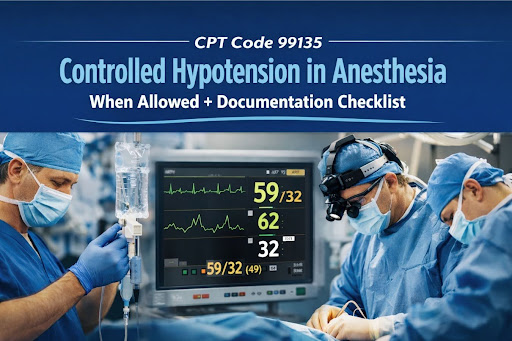
CPT Code 99135 is an add-on qualifying circumstance code used when anesthesia involves induced, controlled hypotension to reduce surgical blood loss and improve visibility. It typically adds 5 base units to the anesthesia service and is commonly used in complex procedures such as ENT, orthopedic, neurosurgical, or vascular surgeries.
The anesthesia provider must actively induce and manage the reduced blood pressure with continuous monitoring. Documentation should clearly state that controlled hypotension was intentionally performed, often at the surgeon’s request, and must include the technique or medications used and evidence of continuous blood pressure monitoring.
This guide explains when CPT 99135 can be reported, when it is not allowed, and the documentation required to support accurate billing and compliance.
Table of Contents
- What Is CPT Code 99135?
- What Is Controlled Hypotension in Anesthesia?
- Common Surgeries Where Controlled Hypotension Is Used
- When CPT Code 99135 Can Be Reported
- When CPT 99135 Cannot Be Reported
- Documentation Checklist for CPT 99135
- Sample Documentation Statement
- Billing & Reimbursement Consideration for CPT 99135
- Common Billing Mistakes with CPT 99135
- Coding Tips for CPT 99135
- Partner with Summit RCM to Optimize Your Billing and Practice Efficiency
What Is CPT Code 99135?
CPT Code 99135 is defined as:
Anesthesia for procedures requiring controlled hypotension (add-on code).
This is an add-on code, meaning it cannot be reported alone. It must be reported in addition to a primary anesthesia service code when the anesthesiologist intentionally lowers the patient’s blood pressure to reduce bleeding or improve surgical conditions.
Key characteristics of CPT 99135:
- It is reported in addition to the base anesthesia CPT code.
- It applies only when controlled hypotension is intentionally induced.
- It requires medical necessity and documentation.
- It is typically used in procedures where bleeding reduction significantly benefits surgical outcomes.
Controlled hypotension requires careful monitoring, drug administration, and continuous anesthetic management, which is why CPT recognizes it as an additional service.
What Is Controlled Hypotension in Anesthesia?
Controlled hypotension is an intentional reduction of systemic blood pressure during anesthesia to minimize blood loss and improve the surgical field.
Typically, the anesthesiologist lowers the mean arterial pressure (MAP) by about 20–30% from baseline, or keeps it within a range such as 50–65 mmHg, depending on the patient's condition.
The primary goals include:
- Reducing intraoperative blood loss
- Improving surgical visibility
- Shortening surgical time
- Decreasing the need for blood transfusions
Controlled hypotension is carefully managed to avoid complications such as:
- Organ ischemia
- Stroke
- Kidney injury
- Cardiovascular instability
Because of these risks, it requires advanced anesthetic management and continuous monitoring.
Common Surgeries Where Controlled Hypotension Is Used
Controlled hypotension is most often used in surgeries where bleeding can obstruct the surgeon’s view.
Common examples include:
Orthopedic Surgery
- Spinal fusion
- Scoliosis correction
- Joint replacement surgery
ENT (Ear, Nose, Throat) Surgery
- Functional endoscopic sinus surgery (FESS)
- Nasal surgery
- Tumor removal
Neurosurgery
- Brain tumor removal
- Intracranial procedures
Plastic and Reconstructive Surgery
- Rhinoplasty
- Facial reconstruction
Vascular Surgery
- Selected vascular procedures requiring blood loss control
In these procedures, even small amounts of bleeding can significantly reduce surgical visibility, making controlled hypotension beneficial.
When CPT Code 99135 Can Be Reported
CPT 99135 can be billed only when controlled hypotension is intentionally induced and managed by the anesthesia provider.
The following conditions must be met:
1. Intentional Blood Pressure Reduction
The anesthesia provider must actively lower the patient’s blood pressure using anesthetic techniques or medications.
This is not simply treating naturally occurring low blood pressure.
Common medications used include:
- Nitroglycerin
- Sodium nitroprusside
- Esmolol
- Propofol infusion adjustments
- Inhalational anesthetics
2. Medical Necessity
The controlled hypotension must be medically necessary for the surgical procedure.
The documentation should clearly state:
- Why was blood pressure reduction required
- How it helped the surgical procedure
For example:
Controlled hypotension was maintained to reduce intraoperative bleeding and improve visualization during sinus surgery.
3. Active Monitoring by the Anesthesia Provider
Controlled hypotension requires continuous monitoring and management.
Monitoring typically includes:
- Continuous blood pressure monitoring
- Arterial line monitoring (often used)
- ECG monitoring
- Oxygen saturation monitoring
- End-tidal CO₂ monitoring
The anesthesia provider must be actively managing the patient’s hemodynamic status.
4. Separate from Routine Anesthesia
Routine fluctuations in blood pressure during anesthesia do not qualify. The hypotension must be deliberately induced and maintained.
When CPT 99135 Cannot Be Reported
There are several situations where CPT 99135 should not be billed. Understanding these situations helps prevent claim denials and compliance risks.
1. Routine Blood Pressure Drops
If the patient's blood pressure drops naturally during anesthesia and the provider manages it, this does not qualify as controlled hypotension. It must be intentional and planned.
2. When Hypotension Is a Complication
If hypotension occurs due to:
- Blood loss
- Medication reaction
- Surgical complications
Then CPT 99135 cannot be billed.
3. Lack of Documentation
Even if controlled hypotension occurred, it cannot be billed without proper documentation. Insufficient documentation is a common reason for denials.
4. When Bundled by Payers
Some payers bundle CPT 99135 into the base anesthesia payment.
In such cases:
- The code may still be reported
- But reimbursement may not be separate
Always verify payer-specific policies.
Documentation Checklist for CPT 99135
Proper documentation is critical for reimbursement and compliance.
The anesthesia record must clearly demonstrate that controlled hypotension was intentional, necessary, and actively managed. Below is a practical checklist for anesthesia providers and coders.
1. Statement of controlled hypotension
The anesthesia note should clearly state that controlled hypotension was induced during the procedure.
2. Reason for the technique
Documentation should explain why the technique was used, such as reducing bleeding or improving surgical visibility.
3. Baseline Blood Pressure
The record should include the patient’s baseline blood pressure and the target range or reduction goal maintained during surgery.
4. Target Blood Pressure
The anesthesia record should show the target blood pressure or MAP range.
Example:
MAP maintained between 55–60 mmHg.
5. Medications Used
Documentation should list medications used to induce hypotension.
Examples include:
- Nitroglycerin infusion
- Sodium nitroprusside
- Propofol infusion
- Beta blockers
6. Duration of Controlled Hypotension
The documentation should indicate how long hypotension was maintained. This shows that the service required ongoing management.
7. Monitoring Techniques
The record should include monitoring methods such as:
- Arterial line placement
- Continuous blood pressure monitoring
- Hemodynamic monitoring
8. Active anesthesia management
The anesthesia provider must document active management.
Example statement:
Controlled hypotension was induced and maintained throughout the procedure to minimize surgical bleeding.
Sample Documentation Statement
Below is an example of compliant documentation.
Example:
Controlled hypotension was intentionally induced using nitroglycerin infusion to maintain MAP between 55–60 mmHg during endoscopic sinus surgery. Continuous arterial blood pressure monitoring was utilized. The technique was necessary to minimize bleeding and improve surgical visualization.
This type of documentation supports CPT 99135 billing.
Billing & Reimbursement Consideration for CPT 99135
CPT 99135 is typically assigned additional anesthesia units.
However, reimbursement varies depending on:
- Insurance payer
- Medicare policies
- Local coverage determinations
Some payers:
- Provide additional payment
- Bundle it into the anesthesia service
Therefore, payer contract review is important.
Total anesthesia payment formula
Anesthesia reimbursement generally follows this formula:
Total Units = Base Units + Time Units + Modifying Units
When CPT 99135 is applicable, the 5 qualifying circumstance units are added to the total unit calculation.
Example billing calculation
- Primary anesthesia base units: 10
- Anesthesia time units: 8
- Qualifying circumstance (99135): 5
- Total units = 23
The final payment is calculated by multiplying the total anesthesia units by the payer’s anesthesia conversion factor.
Common Billing Mistakes with CPT 99135
Incorrect billing for CPT 99135 can result in denials or audits. Below are common mistakes.
1. Billing Without Documentation
Many claims are denied because the anesthesia record does not explicitly mention controlled hypotension.
2. Reporting for Routine Hypotension
Normal blood pressure fluctuations during anesthesia do not qualify. The hypotension must be planned and actively managed
3. Missing medical necessity
The documentation must explain why controlled hypotension was required for the procedure. Without this justification, the code may be rejected.
4. Missing Medication Documentation
The anesthesia record should document the drugs or techniques used to lower blood pressure.
5. Ignoring payer policies
Some payers bundle CPT 99135 into the base anesthesia service. Failing to review payer guidelines can lead to unexpected reimbursement issues.
Coding Tips for CPT 99135
To ensure proper billing, follow these best practices.
1: Train Anesthesia Providers
Providers should understand documentation requirements.
2: Use Anesthesia Templates
Electronic anesthesia records can include documentation prompts for controlled hypotension.
3: Verify Medical Necessity
Coders should review operative reports to confirm:
- Surgical indication
- Use of hypotensive techniques
4: Audit Anesthesia Records
Regular internal audits help prevent incorrect billing.
5: Communicate with Surgeons
Sometimes surgeons request controlled hypotension. Coordination helps ensure clear documentation.
6. Conduct periodic coding reviews
Regular audits help ensure accurate reporting and proper documentation compliance.
You can also explore our guide on Virtual Assistant Services for Medical Practice to simplify scheduling, patient communication, and daily administrative tasks.
Partner with Summit RCM to Optimize Your Billing and Practice Efficiency
Accurate coding and strong documentation are essential for maintaining compliance and maximizing reimbursement. Healthcare organizations often face challenges managing complex billing requirements while keeping up with daily administrative tasks. This is where Summit RCM can help.
Summit RCM provides specialized wound care billing services that help practices improve claim accuracy, reduce denials, and accelerate reimbursements. In addition, their virtual medical assistant services support healthcare providers with administrative tasks such as appointment scheduling, documentation assistance, patient coordination, and workflow management.
Partner with Summit RCM to build a more efficient and compliant revenue cycle today.