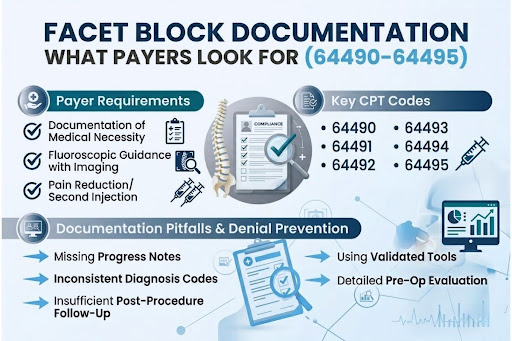
Facet joint injections (commonly referred to as facet blocks) are among the most scrutinized procedures in interventional pain management billing. CPT codes 64490–64495 represent diagnostic or therapeutic injections into the paravertebral facet joints or the medial branch nerves innervating those joints. While these procedures are clinically valuable, they are also a frequent target for claim denials, audits, and preauthorization reviews due to inconsistent documentation.
This comprehensive guide explains what payers look for, how to document correctly, and how to avoid denials when billing facet block procedures.
What Do Facet Joint Injection Codes 64490–64495 Mean?
Facet joints are small synovial joints located between vertebrae that help stabilize the spine. These joints can become inflamed or arthritic, leading to chronic spinal pain. Facet blocks are used for:
- Diagnosis: Identifying the source of pain
- Therapy: Providing temporary or long-term relief
During the procedure, a physician injects anesthetic (with or without steroids) into the joint or surrounding nerves.
CPT Code Breakdown
Facet block codes are divided by spinal region and number of levels:
| Region |
First Level |
Second Level |
Third+ Level |
| Cervical/Thoracic |
64490 |
64491 |
64492 |
| Lumbar/Sacral |
64493 |
64494 |
64495 |
Each code represents one facet joint level, not individual nerves.
Why Documentation Matters More Than Ever
Facet injections are high-risk from a compliance perspective because:
- They are often repeated procedures
- They can be diagnostic or therapeutic
- They require strict medical necessity justification
Payers including Medicare and commercial insurers require extensive documentation to ensure:
- The procedure is medically necessary
- Conservative treatments have failed
- Proper coding and level selection are used
- There is objective evidence of benefit
Failure to meet these requirements results in:
- Claim denials
- Payment recoupments
- Prepayment audits
Key Documentation Elements Payers Expect
A. Medical Necessity
The most critical requirement is proving that the procedure is necessary.
What must be documented:
- Chronic pain (typically >3 months)
- Pain localized to facet joints
- Functional limitations (mobility, daily activity impairment)
- Failed conservative treatments such as:
- Physical therapy
- NSAIDs or medications
- Behavioral therapy
Payers often define conservative therapy as a combination of medications and physical or cognitive therapies.
Tip: Always include duration, severity, and prior treatments with outcomes.
B. Clear Diagnosis and Indications
Facet blocks are not approved for vague diagnoses.
Acceptable conditions include:
- Facet arthropathy
- Spondylosis
- Chronic axial spine pain
- Degenerative disc disease (with facet involvement)
Poor documentation examples:
- “Back pain” (too vague)
- “Neck pain” without localization
Payers expect precise anatomical correlation.
C. Diagnostic vs Therapeutic Intent
This is one of the biggest payer concerns.
Diagnostic Facet Blocks
- Used to confirm pain source
Must show:
- Immediate pain relief
- Percentage of improvement
Therapeutic Injections
Require:
- Prior successful diagnostic block
- Documentation explaining why radiofrequency ablation (RFA) is not used
Documentation must clearly state intent otherwise claims may be denied.
D. Imaging Guidance Requirement
Payers require fluoroscopy or CT guidance.
- Ultrasound-guided injections are typically not covered
- Imaging must be documented in the procedure note
Missing imaging documentation = automatic denial.
E. Levels and Anatomical Accuracy
Facet injections are billed per level, not per nerve.
Documentation must include:
- Exact levels treated (e.g., L4–L5)
- Laterality (left, right, bilateral)
- Number of levels
Important rule:
- Two nerves innervate one facet joint
- But billing counts one level per joint
F. Laterality and Modifier Usage
For bilateral procedures:
- Use modifier -50
- Report one unit per level
Incorrect modifier usage is a top denial reason.
G. Response to Treatment
Payers require objective outcome tracking.
For diagnostic injections:
- Percentage of pain relief
- Duration of relief
- Functional improvement
For repeat procedures:
- Evidence of sustained benefit
- Justification for additional injections
Without documented improvement, further procedures are often denied.
H. Frequency Limitations
Payers impose strict limits.
Typical Medicare guideline:
- Maximum 4 sessions per region per year
Overuse without justification triggers audits.
Preauthorization Requirements
Most payers now require prior authorization for facet injections.
Required documentation:
- Clinical notes
- Imaging reports
- Conservative treatment history
- Pain assessment scores
- Planned levels and region
Incomplete submissions lead to:
Common Documentation Mistakes That Trigger Denials
Even minor documentation gaps can lead to costly denials, delayed reimbursements, and increased audit risk. Understanding these common pitfalls can help ensure cleaner claims and faster approvals.
1. Missing Medical Necessity
One of the most frequent reasons for denial is failure to clearly establish medical necessity.
Common issues include:
- No documentation of chronic pain (typically lasting more than 3 months)
- Lack of detail on severity and functional limitations
- Missing evidence of failed conservative treatments such as medications, physical therapy, or other non-invasive approaches
Tip: Always connect the patient’s symptoms, diagnosis, and failed treatments to justify the procedure.
2. Incorrect Level Coding
Facet joint injections are billed per joint level, not per individual nerve. Misunderstanding this leads to frequent coding errors.
Common issues include:
- Counting medial branch nerves instead of facet joints
- Billing more levels than actually treated
- Mismatch between procedure notes and billed codes
Tip: Clearly document the exact spinal levels treated (e.g., L4–L5) and ensure coding aligns with that.
3. Lack of Imaging Documentation
Imaging guidance is a non-negotiable requirement for most players.
Common issues include:
- Not specifying whether fluoroscopy or CT guidance was used
- Missing imaging details in the procedure note
- Using unsupported imaging methods without justification
Tip: Always include the type of imaging used and confirm it in the procedural documentation.
4. No Outcome Documentation
Payers expect objective evidence that the procedure provided value.
Common issues include:
- Missing pre- and post-procedure pain scores
- No percentage of pain relief documented
- Lack of functional improvement details
Tip: Document measurable outcomes, such as “patient experienced 70% pain relief for 6 hours.”
5. Overuse of Procedures
Repeated injections without proper justification raise red flags and often trigger audits.
Common issues include:
- Exceeding payer frequency limits (e.g., more than 4 sessions per year per region)
- No documentation supporting continued need for injections
- Repeating procedures without demonstrating prior benefit
Tip: Always justify repeat procedures with documented patient improvement.
6. Modifier Errors
Incorrect use of modifiers can result in immediate claim rejection.
Common issues include:
- Missing modifier -50 for bilateral procedures
- Incorrect application of modifiers based on payer rules
- Billing duplicate lines instead of using proper modifiers
Tip: Verify payer-specific guidelines for modifier usage, especially for bilateral injections.
Diagnostic vs Therapeutic Documentation: What Payers Expect at Each Stage
Understanding the distinction between diagnostic and therapeutic facet joint injections is critical, as payers apply different documentation standards to each. Failure to clearly differentiate between the two is a common reason for denials.
Diagnostic Phase
The primary goal of diagnostic facet blocks is to confirm that the facet joint is the source of pain. Because this phase determines medical necessity for further treatment, payers scrutinize it very closely.
What Payers Expect
- Typically two separate diagnostic injections at the same level
- Demonstration of significant pain relief, usually in the range of 50% to 80% or greater
- Consistency in patient response across both injections
Required Documentation
To support medical necessity, documentation must be precise and measurable:
- Baseline pain score (e.g., 8/10 before the procedure)
- Post-procedure pain score (e.g., reduced to 2/10)
- Percentage of pain relief clearly stated
- Duration of relief (e.g., relief lasted 6–8 hours or several days)
- Functional improvement, such as increased mobility or ability to perform daily activities
Tip: Avoid vague statements like “patient felt better.” Always quantify the improvement.
Therapeutic Phase
Therapeutic injections are performed to provide ongoing pain relief, but they are only considered medically necessary after successful diagnostic confirmation.
When Therapeutic Injections Are Allowed
- Diagnostic facet blocks have demonstrated clear and consistent pain relief
- The patient is not an ideal candidate for radiofrequency ablation (RFA), or there is a documented reason to delay or avoid it
Required Documentation
Payers require strong justification to continue with therapeutic injections:
- Proof of prior diagnostic success (link to earlier results)
- Reason RFA is not performed, such as:
- Patient preference
- Medical contraindications
- Temporary treatment strategy
- Evidence of continued benefit, including:
- Ongoing pain relief percentages
- Functional improvements
- Duration of relief from previous injections
Tip: Each repeat injection must be justified individually; do not assume prior approval guarantees future reimbursement.
Payer-Specific Expectations
While documentation standards for facet joint injections are broadly similar, each payer may apply slightly different rules, thresholds, and review criteria. Understanding these nuances is essential to avoid denials and ensure smooth reimbursement.
Medicare
Medicare tends to follow clearly defined Local Coverage Determinations (LCDs), making its requirements more structured but also more strictly enforced.
Key Expectations
- Strict adherence to LCD guidelines for medical necessity and documentation
- Mandatory use of imaging guidance such as fluoroscopy or CT
- Enforcement of frequency limitations (typically capped annually per spinal region)
- Clear distinction between diagnostic and therapeutic procedures
- Detailed documentation of pain relief and functional improvement
Important: Even minor deviations from LCD requirements can result in claim denial or post-payment audits.
Commercial Payers
Commercial insurers often have more variability in policies, which can make compliance more complex.
Key Expectations
- Stricter preauthorization requirements, often requiring detailed clinical records upfront
- Additional scrutiny on medical necessity and conservative treatment history
- Some payers may classify therapeutic facet injections as investigational or not medically necessary
- Variations in frequency limits, modifier usage, and documentation standards
Important: Requirements can differ significantly between insurers, even for the same procedure.
Always verify payer-specific guidelines before submitting claims. Reviewing policies in advance and aligning documentation accordingly can significantly reduce denials, prevent delays, and improve overall reimbursement outcomes.
Proper Coding Guidelines
Accurate coding is essential for proper reimbursement and compliance when billing facet joint injections. Even small errors in code selection or modifier usage can lead to denials or audits. Below are the key coding principles every provider should follow.
A. Primary vs Add-On Codes
Facet joint injection codes are structured with one primary code for the first level and add-on codes for additional levels within the same spinal region.
Code Structure
- First level: 64490 (cervical/thoracic) or 64493 (lumbar/sacral)
- Second level: 64491 or 64494
- Third and additional levels: 64492 or 64495
Add-on codes cannot be billed independently and must always be reported alongside the appropriate primary code.
Tip: Ensure documentation clearly supports each additional level billed.
B. Bilateral Procedures
When injections are performed on both sides of the spine at the same level, proper modifier usage is critical.
Key Rules
- Use modifier -50 to indicate a bilateral procedure
- Report one unit per level, not separate line items for left and right (unless the payer specifically requires it)
Tip: Always check payer-specific billing preferences, as some insurers may have unique requirements for bilateral reporting.
C. Maximum Levels Per Session
Most payers place limits on the number of levels that can be treated and billed during a single session.
General Guidelines
- Typically limited to a maximum of 3 levels per spinal region per session
- Billing beyond this limit requires strong clinical justification and may still be denied
Tip: Overcoding levels without clear documentation is a common audit trigger.
Proper coding is not just about selecting the correct CPT codes it also requires alignment between clinical documentation, procedural details, and payer rules. Staying precise and consistent in coding practices can significantly reduce denials and improve reimbursement efficiency.
Sample Documentation Template
A well-structured documentation template helps ensure consistency, supports medical necessity, and reduces the risk of denials. Below is a refined, audit-ready framework that providers can follow for every facet joint injection procedure.
1. Patient Evaluation
This section establishes the clinical foundation for the procedure and must clearly justify why the injection is needed.
Include:
- Chief Complaint: A clear and detailed description of pain (e.g., lower back pain radiating to hips)
- Pain Duration and Severity:
- Duration (e.g., 6 months)
- Pain scale (e.g., 8/10)
- Functional Limitations:
- Difficulty walking, standing, or sitting
- Impact on daily activities or quality of life
Tip: Be specific and avoid vague terms like “chronic pain” without context.
2. Conservative Treatment History
Payers require proof that non-invasive treatments were attempted and failed before proceeding with injections.
Include:
- Medications Tried: NSAIDs, muscle relaxants, or other pain management drugs
- Therapies Attempted: Physical therapy, chiropractic care, or behavioral therapy
- Duration of Each Treatment:
- Outcomes: Lack of relief or only temporary improvement
Tip: Clearly document why conservative treatments were insufficient.
3. Procedure Details
This is one of the most critical sections for coding accuracy and compliance.
Include:
- Levels Treated: Exact spinal levels (e.g., L4–L5, L5–S1)
- Laterality: Left, right, or bilateral
- Imaging Guidance Used: Fluoroscopy or CT (must be explicitly stated)
- Type of Injection: Diagnostic or therapeutic
Tip: Ensure procedure notes align exactly with billed CPT codes.
4. Outcome and Response
Payers require measurable evidence that the procedure provided benefit, especially for repeat injections.
Include:
- Pain Relief Percentage: (e.g., 70% improvement)
- Pre- and Post-Procedure Pain Scores
- Duration of Relief: Hours, days, or weeks
- Functional Improvement: Improved mobility, ability to perform daily tasks
Tip: Quantify results whenever possible to avoid subjective statements like “patient improved.”
Audit-Proof Documentation Strategy
In today’s highly regulated billing environment, strong documentation is your first line of defense against denials, audits, and payment delays. Implementing a structured and consistent approach can significantly improve claim approval rates and overall compliance.
1. Standardize Documentation Templates
Using consistent, structured templates ensures that no critical information is missed during patient evaluation or procedure documentation.
Best Practices:
- Create procedure-specific templates for facet injections
- Include mandatory fields such as medical necessity, levels treated, imaging, and outcomes
- Train staff and providers to follow the same documentation format
Benefit: Reduces variability and ensures all payer-required elements are captured.
2. Track and Document Outcomes Clearly
Payers expect objective evidence that the procedure delivers measurable value.
Best Practices:
- Record baseline and post-procedure pain scores
- Document percentage of pain relief
- Include functional improvements such as mobility or daily activity performance
- Track duration of relief for each session
Benefit: Strengthens justification for both initial and repeat procedures.
3. Justify Every Repeat Injection
Repeat procedures are closely monitored and must be supported with clear clinical reasoning.
Best Practices:
- Reference results from prior injections
- Demonstrate continued or recurring pain
- Explain why additional treatment is necessary
- Include rationale if alternatives like radiofrequency ablation (RFA) are not pursued
Benefit: Prevents denials related to overuse or lack of medical necessity.
4. Align Coding with Clinical Documentation
Coding errors often occur when there is a mismatch between what was performed and what was billed.
Best Practices:
- Ensure CPT codes match documented levels and regions
- Verify laterality and modifier usage
- Cross-check procedure notes before claim submission
- Conduct periodic internal audits for accuracy
Benefit: Minimizes coding errors and reduces the risk of claim rejection or audit flags.
An audit-proof strategy is built on consistency, clarity, and accuracy. By standardizing processes, tracking outcomes, justifying treatments, and aligning coding with documentation, providers can significantly reduce denials and maintain long-term compliance.
The Role of Technology in Compliance
As payer requirements become more complex, leveraging technology is no longer optional; it is essential for maintaining accuracy, efficiency, and compliance in facet joint injection documentation and billing.
Key Technologies Used in Modern Practices
1. EHR-Based Documentation Templates
Electronic Health Records (EHR) systems allow providers to use standardized, procedure-specific templates.
Benefits include:
- Ensuring all required fields are completed
- Reducing missing or inconsistent documentation
- Improving workflow efficiency for providers
2. Advanced Coding and Billing Software
Specialized coding tools help align clinical documentation with the correct CPT codes and payer rules.
Benefits include:
- Automated code suggestions based on documentation
- Built-in checks for modifier usage and level limits
- Reduced risk of coding errors and claim rejections
3. AI-Assisted Documentation Tools
Artificial intelligence is increasingly being used to enhance documentation accuracy and completeness.
Benefits include:
- Real-time prompts for missing documentation elements
- Automated summaries of patient encounters
- Improved consistency across providers
- Faster documentation turnaround
When used effectively, these technologies provide measurable improvements across the entire billing cycle:
- Reduce errors by standardizing documentation and minimizing manual input
- Improve compliance by aligning records with payer-specific requirements
- Speed up approvals through cleaner, more complete claim submissions
- Enhance audit readiness with structured and traceable documentation
Technology acts as a powerful support system for providers, helping bridge the gap between clinical care and payer expectations. Practices that integrate EHR templates, coding tools, and AI-driven documentation are better positioned to reduce denials, streamline workflows, and maintain long-term compliance.
Future Trends in Facet Block Reimbursement
Facet joint injection reimbursement is evolving as payers place greater emphasis on clinical outcomes, cost-effectiveness, and long-term patient benefit. Providers must stay ahead of these changes to maintain compliance and ensure consistent reimbursement.
Key Trends Shaping the Future
1. Shift Toward Value-Based Care
Payers are increasingly moving away from volume-based models toward value-based care, where reimbursement is tied to patient outcomes rather than the number of procedures performed.
What this means:
- Greater focus on measurable pain relief and functional improvement
- Increased need for data-driven documentation
- Reduced tolerance for repetitive procedures without clear benefit
2. Increased Scrutiny on Repeat Injections
Repeated facet injections are already a major audit trigger, and scrutiny is expected to intensify.
What this means:
- Stronger justification required for each additional session
- Closer monitoring of frequency limits and clinical necessity
- Higher likelihood of prepayment reviews and audits
3. Preference for Long-Term Treatment Solutions
Payers are showing a growing preference for longer-lasting interventions, particularly radiofrequency ablation (RFA), over repeated short-term injections.
What this means:
- Providers must clearly explain why RFA is not performed when continuing injections
- Increased emphasis on transitioning patients from diagnostic to definitive treatments
- Potential reduction in coverage for repeated therapeutic injections
What to Expect in the Future of Facet Block Reimbursement
Reimbursement for facet block procedures is steadily shifting toward a more data-driven and outcome-focused model. Providers can expect stricter documentation standards across all payer types, with increased emphasis on clearly demonstrating medical necessity, measurable pain relief, and functional improvement. Simply performing the procedure will no longer be enough documentation to prove its value.
At the same time, payer policies are becoming more dynamic, with frequent updates, tighter coverage criteria, and evolving frequency limitations. This makes it essential for practices to stay current and adapt quickly to avoid unexpected denials. Adding to this, insurers are now using advanced analytics and automated review systems to evaluate claims more rigorously, meaning even small inconsistencies can trigger rejections or audits.
Ultimately, the future of facet block reimbursement will be driven by outcomes, accountability, and efficiency. Providers who take a proactive approach to documentation and align their processes with evolving payer expectations will be in a stronger position to reduce denials, successfully navigate audits, and maintain consistent reimbursement.
To truly enhance efficiency and scale your operations, explore How Medical Billing Services Can Transform a Small Practice and discover how the right support can drive real growth and financial stability.
Key Takeaways
Facet block documentation for CPT 64490–64495 is complex but manageable with the right approach.
What payers care about most:
- ✔ Medical necessity
- ✔ Accurate level and region documentation
- ✔ Imaging confirmation
- ✔ Clear diagnostic vs therapeutic intent
- ✔ Measurable outcomes
- ✔ Proper coding and modifiers
To further strengthen your billing strategy and ensure long-term success, it’s important to choose the right partner. Explore our guide on Factors to Look for When Choosing a Medical Billing Company to make a well-informed decision.
Strengthen Reimbursement Success with Proper Documentation and Expert RCM Support
Facet joint injections remain a valuable diagnostic and therapeutic tool, but only when properly documented. In today’s reimbursement environment, documentation is just as important as the procedure itself.
Providers who understand payer expectations and implement structured documentation practices will:
- Reduce denials
- Improve reimbursement
- Avoid audits
Partnering with a trusted revenue cycle management provider like Summit RCM can further strengthen your billing and compliance processes. By incorporating specialized Medical Billing Services into your workflow, practices can ensure greater accuracy in coding, thorough documentation review, and efficient denial management. This not only streamlines operations but also helps providers stay aligned with payer guidelines, ultimately maximizing revenue while minimizing risk.
.png)