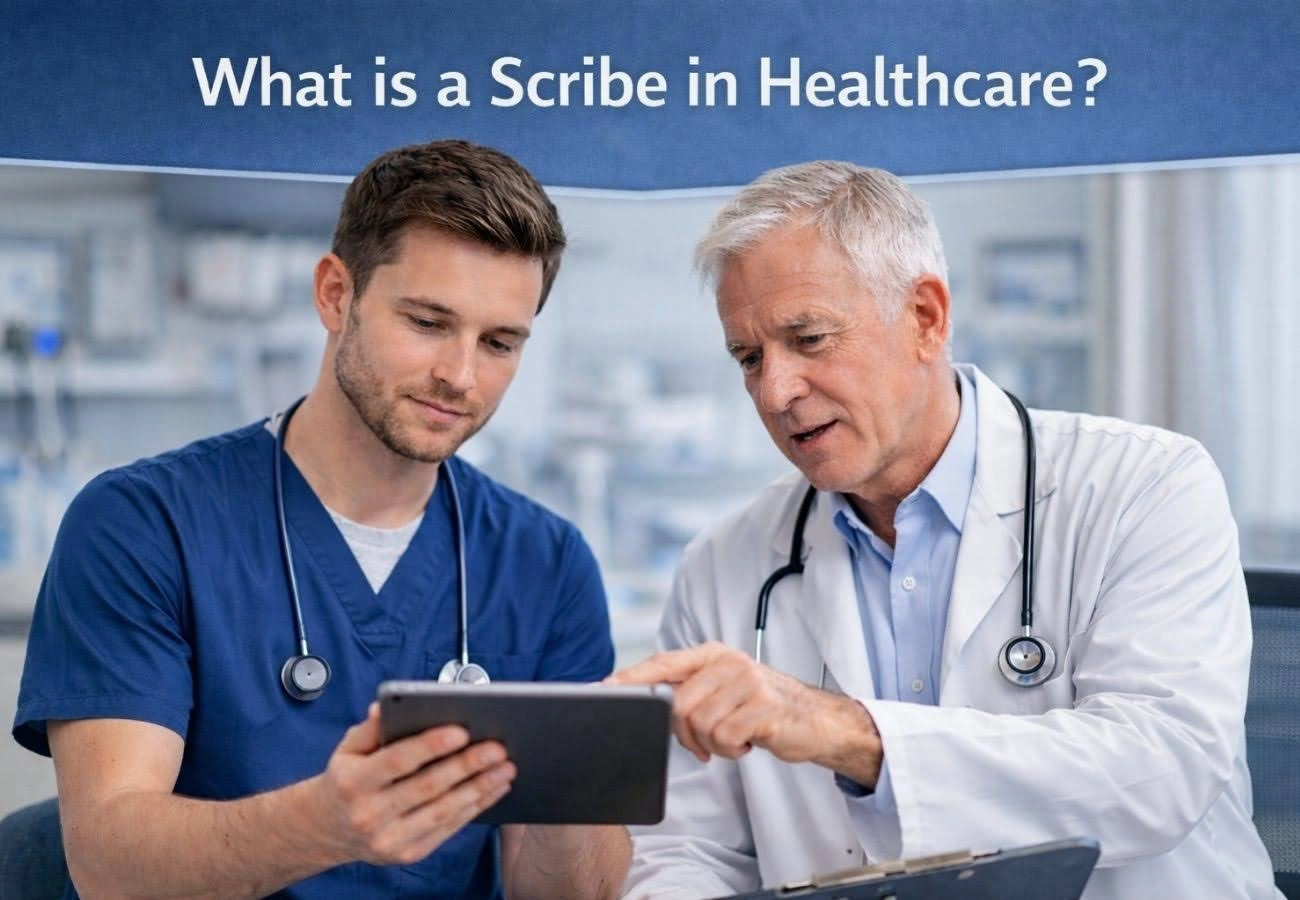
The modern healthcare system operates at an extraordinary pace, where precision, detailed
documentation, and efficiency are essential to delivering high-quality patient care.
Medical scribes have quickly become vital members of healthcare teams, serving as real-time
documentation specialists who capture every detail of a patient visit with accuracy and care.
Medical scribes handle the complexities of EHR documentation, allowing physicians to focus their
time and energy on what truly defines their profession, connecting with patients, making
informed clinical decisions, and delivering compassionate, high-quality care.
This article takes a closer look at the role of medical scribes in modern healthcare, exploring
their responsibilities, required skills, training pathways, and the meaningful impact they have
on clinical efficiency, accuracy, and overall patient experience.
What is a Healthcare Scribe?
A medical scribe (or healthcare scribe) is a trained professional who assists physicians,
nurse practitioners, and other healthcare providers by documenting clinical encounters in
real time. Their primary duty is to enter information into the patient’s electronic health
record (EHR) during or immediately after a patient visit.
Essentially, scribes act as the provider’s right hand, handling administrative and clerical
aspects of documentation so that clinicians can devote more attention to diagnosing,
treating, and communicating with patients.
How Medical Scribes Became Essential in Modern Healthcare
Before electronic health records (EHRs) became a standard part of medical practice, doctors
used to write down their notes on paper charts, often in between patient visits or at the
end of a long day. It wasn’t the most efficient system, but it was simple and familiar. Then
came the digital transformation of healthcare. Electronic health records (EHRs) made
information easier to access and improved the accuracy of patient records, but they also
introduced a new challenge, an overwhelming documentation workload.
Today, physicians spend almost two hours entering data for every hour they spend with
patients. That imbalance has taken a toll, leading to frustration, burnout, and less time
for genuine patient interaction.
To help ease that burden, medical scribes were introduced. Scribes handle the EHR tasks and
document clinical details in real time, allowing doctors to focus on what truly matters;
their patients.
Core Responsibilities of a Medical Scribe
The duties of a healthcare scribe vary depending on the setting, such as the emergency
department, outpatient clinic, telemedicine, or inpatient care, but generally include:
1. Real-Time Documentation
Scribes record all relevant aspects of the patient encounter, including:
- Chief complaint and history of present illness (HPI)
- Review of systems (ROS)
- Physical exam findings as dictated by the provider
- Assessment and plan (diagnosis, tests, treatment plans)
- Follow-up instructions and prescriptions
2. Electronic Health Record (EHR) Management
Scribes are proficient in using EHR software to:
- Update patient demographics and medical history
- Enter lab and imaging results
- Manage documentation templates
- Ensure accuracy and compliance with regulatory requirements (HIPAA, CMS)
3. Administrative and Support Tasks
In many settings, scribes also:
- Prepare charts before appointments
- Assist with order entry (under provider supervision)
- Communicate with ancillary staff (nurses, radiologists, pharmacists)
- Handle documentation for billing and coding purposes
4. Real-Time Communication Support
In telemedicine and hybrid settings, scribes help by managing video consultations, recording
patient data, and ensuring smooth digital interactions between providers and patients.
Where Do Scribes Work?
Healthcare scribes are employed in various environments across the medical field:
- Emergency Departments (ED): The most common setting. ED scribes assist physicians with
high patient volume and complex documentation needs.
- Outpatient Clinics: Scribes document encounters for family physicians, specialists
(orthopedics, dermatology, cardiology), and primary care teams.
- Hospital Rounds / Inpatient Settings: They accompany physicians during rounds to record
progress notes and care plans.
- Telemedicine Services: With virtual healthcare’s growth, remote scribes now document
digital consultations.
- Surgical / Specialty Clinics: Scribes assist in preoperative and postoperative
documentation.
Types of Medical Scribes
Scribing has evolved beyond the traditional in-person role. Today, multiple formats exist:
1. In-Person Scribes
These scribes are physically present in the examination or procedure room, documenting in
real time alongside the physician.
In-person scribes offer several advantages, including immediate communication with the
physician, real-time clarification of medical details, and the opportunity to build strong
working relationships with providers. However, this model also has its drawbacks, such as
limited flexibility and higher staffing costs compared to remote or virtual scribing
options.
2. Virtual / Remote Scribes
Remote scribes work from a distance using secure technology. They listen to or view
encounters through telehealth platforms and input data into the EHR.
Virtual scribes are cost-effective, scalable, and do not require physical workspace, making
them an efficient option for many healthcare settings. However, their effectiveness depends
on reliable internet connections and the proper use of digital communication tools.
3. Hybrid Scribes
Some organizations adopt a hybrid approach where scribes work both onsite and remotely
depending on patient volume and workflow demands.
Skills and Qualities of a Successful Scribe
Being a healthcare scribe requires more than just typing skills. The role demands medical
knowledge, professionalism, and strong interpersonal skills.
1. Key Skills
- Medical Terminology: Understanding the language of medicine is essential for accurate
documentation.
- Attention to Detail: Accuracy in recording diagnoses, medications, and procedures is
critical.
- Fast and Accurate Typing: Speed matters when transcribing during live encounters.
- EHR Proficiency: Familiarity with popular systems like Epic, Cerner, or Meditech.
- Time Management: Ability to keep up with fast-paced clinical workflows.
- HIPAA Compliance: Maintaining confidentiality of patient information.
2. Professional Attributes
- Adaptability: Clinical environments can be unpredictable.
- Communication Skills: Clear collaboration with physicians and patients.
- Empathy: Understanding patient emotions without direct involvement.
- Discretion: Remaining professional and composed during sensitive interactions.
Training and Education Requirements
There is no universal requirement for becoming a scribe, but most employers seek candidates
with certain educational backgrounds and certifications.
1. Educational Background
- Minimum: High school diploma or GED
- Preferred: Bachelor’s degree or coursework in pre-med, biology, health sciences, or
nursing
Many students pursuing healthcare careers (e.g., medical school or physician assistant
programs) use scribing as a stepping stone.
2. Training Programs
Training can be provided on the job or through specialized scribe training organizations,
such as:
- ScribeAmerica
- ProScribe
- Elite Medical Scribes
- Scribe-X
Training typically includes:
- Medical terminology and anatomy
- Clinical workflow understanding
- EHR documentation
- Compliance and privacy regulations
- Shadowing and supervised practice
3. Certification Options
While not always mandatory, certification enhances credibility:
- American Healthcare Documentation Professionals Group (AHDPG)
- Certified Medical Scribe Professional (CMSP)
- Medical Scribe Certification Exam (MSCE)
Benefits of Using Scribes in Healthcare
The integration of medical scribes into healthcare teams has proven to deliver significant
benefits, enhancing efficiency, accuracy, and the overall quality of patient care.
1. For Physicians
- Reduced Administrative Burden: Allows physicians to spend more time with patients and
less time typing notes.
- Increased Productivity: More patients seen per shift, faster documentation turnaround.
- Improved Job Satisfaction: Less burnout from charting after hours (“pajama time”).
- Accurate Documentation: Real-time transcription minimizes errors and improves billing
compliance.
2. For Patients
- Enhanced Physician Attention: Providers maintain eye contact and active listening during
visits.
- Improved Communication: Patients feel more valued and heard.
- Faster Care Delivery: Streamlined workflows reduce waiting times.
3. For Healthcare Organizations
- Higher Revenue: Improved documentation accuracy enhances coding and reimbursement.
- Operational Efficiency: Scribes contribute to smoother clinic flow and reduced overtime
costs.
- Data Quality: Consistent documentation supports better analytics and care quality
metrics.
Challenges and Limitations
While the benefits are significant, the scribe model is not without its challenges.
1. Cost of Implementation
Training and employing scribes can be expensive. Facilities must evaluate the cost-benefit
ratio.
2. Privacy and Compliance
Because scribes handle sensitive patient data, ensuring strict adherence to HIPAA
regulations is paramount.
3. Variability in Training
The absence of standardized national training or certification can lead to inconsistencies
in documentation quality.
4. Physician Dependency
Overreliance on scribes might lead some providers to lose proficiency in navigating EHRs
themselves.
5. Technology Integration
In remote scribing, secure and stable internet connections are essential. Technical glitches
can disrupt the workflow.
The Future of Medical Scribing
The healthcare scribe role continues to evolve with advances in technology and artificial
intelligence.
1. Rise of AI-Powered Documentation
AI-driven tools like ambient listening systems (e.g., Nuance Dragon Ambient eXperience,
DeepScribe, or Augmedix) are transforming scribing by automatically generating encounter
notes through voice recognition and natural language processing.
These systems can:
- Transcribe speech in real-time
- Identify clinical concepts (symptoms, diagnoses, treatments)
- Generate structured EHR-ready notes
However, human scribes remain vital for:
- Contextual accuracy
- Clinical judgment
- Relationship management
- Handling exceptions and non-verbal nuances
2. Hybrid Human–AI Collaboration
Future models may combine AI automation with human oversight, where scribes review and
refine AI-generated documentation, ensuring precision and personalization.
3. Expanding Opportunities
Beyond hospitals and clinics, scribes are now employed in:
- Telehealth companies
- Home health agencies
- Insurance reviews
- Clinical research documentation
Career Growth and Outlook
The future looks bright for medical scribes, with growing opportunities across healthcare
settings and a clear path toward long-term professional growth.
1. Job Market
According to the U.S. Bureau of Labor Statistics, the demand for healthcare support roles,
including scribes, is projected to grow faster than average due to the continued
digitization of health records and increased patient volumes.
2. Career Pathways
Many scribes use this experience as a launchpad into healthcare careers such as:
- Physician Assistant (PA)
- Medical Doctor (MD or DO)
- Registered Nurse (RN)
- Health Information Manager
- Clinical Research Coordinator
Scribing offers hands-on exposure to medical terminology, clinical decision-making, and
patient care workflows, providing a valuable foundation for further professional
development.
To explore proven strategies that help healthcare organizations boost collections and reduce
claim denials, check out our article Proactive
Medical Billing: Expert Tips to Maximize Your
Revenue.
A Day in the Life of a Medical Scribe
A typical day for a scribe may look like this:
1. Pre-Shift Preparation:
- Review scheduled patients and prior notes.
- Prepare EHR templates.
2. During Patient Encounters:
- Document HPI, exam findings, and physician assessments in real time.
- Input lab results or diagnostic orders as instructed.
3. Post-Encounter Duties:
- Review and finalize notes.
- Assist with coding and compliance checks.
- Communicate with staff to ensure documentation completion.
4. End of Day:
- Ensure charts are complete.
- Sync with the provider for any clarifications or addenda.
This structured workflow ensures accurate, timely, and compliant medical records.
Ethical and Legal Considerations
Scribes must operate under strict ethical and legal frameworks:
- HIPAA Compliance: Safeguarding patient confidentiality is non-negotiable.
- Scope of Practice: Scribes are not clinical decision-makers. They document only what the
provider dictates.
- Professional Conduct: Maintaining neutrality, avoiding patient advice, and upholding
professional boundaries.
Healthcare organizations must establish clear policies for scribe supervision, documentation
review, and auditing to mitigate risk.
For a closer look at how professional billing support can help small practices improve cash
flow and operational efficiency, visit our article How
Medical Billing Services Can
Transform a Small Practice.
Summit RCM’s Commitment to Quality and Innovation in Healthcare
The healthcare scribe is far more than a data entry assistant; they are an essential partner
in patient care efficiency, documentation accuracy, and clinician well-being. By handling
the complexities of EHR documentation, medical scribes free clinicians to focus on genuine
patient interaction and restore the human connection at the heart of medicine.
In essence, medical scribes serve as the vital link between technology and compassion,
ensuring that as healthcare becomes more digital, it never loses its human touch.
At Summit RCM, we understand the critical role accurate, timely documentation plays in the
success of every healthcare organization. Through our expertise in Healthcare Data Analytics
and clinical documentation, we empower providers with meaningful insights that enhance
decision-making and operational efficiency. As the future of healthcare continues to evolve,
Summit RCM remains committed to empowering clinicians, improving documentation quality, and
driving efficiency across every aspect of patient care.
.png)