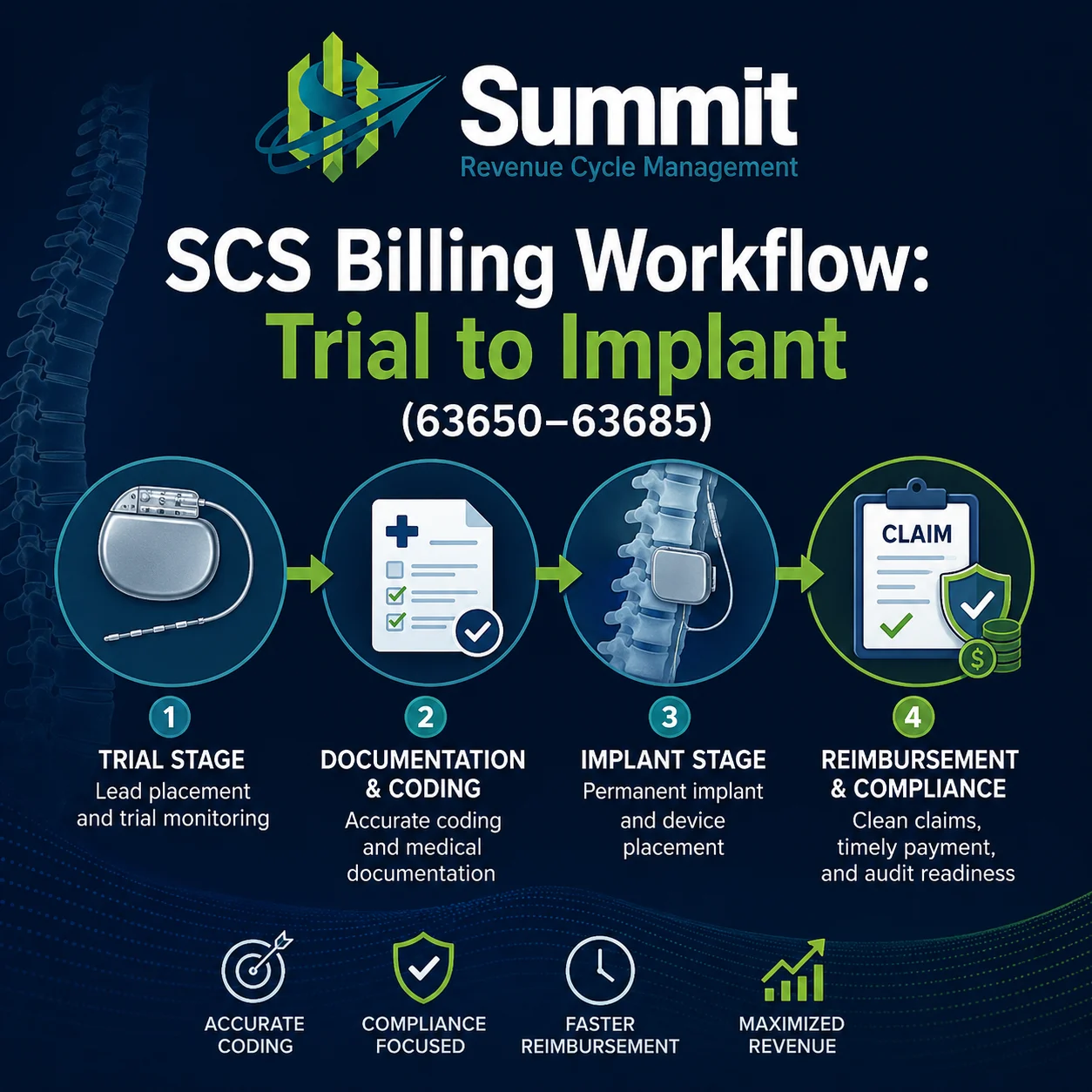
Spinal cord stimulation (SCS) is a highly effective treatment for chronic pain, but from a billing perspective, it involves a multi-step and tightly regulated workflow. The transition from trial stimulation (CPT 63650) to permanent implantation (CPT 63685) is where most billing errors occur.
Missing documentation, incorrect coding, or gaps in authorization can lead to denials, delays, and revenue loss. To avoid this, each step must be clearly documented, correctly coded, and aligned with payer requirements.
This guide breaks down the SCS billing workflow step by step so you can reduce errors and ensure consistent reimbursement.
Understanding the SCS Workflow
Before diving into billing, it’s important to understand how the SCS process works clinically.
What is Spinal Cord Stimulation (SCS)?
SCS is a pain management therapy that uses electrical impulses to block pain signals before they reach the brain. It’s commonly used for:
- Failed back surgery syndrome
- Chronic neuropathic pain
- Complex regional pain syndrome (CRPS)
Two Key Stages of SCS Treatment
The SCS process typically includes:
- Trial Phase (Temporary)
- Permanent Implantation Phase
Each stage has its own CPT codes, billing rules, and documentation requirements.
SCS Billing Workflow: Trial to Implant (63650 → 63685)
Billing for spinal cord stimulation (SCS) follows a step-by-step workflow, from trial (CPT 63650) to permanent implant (CPT 63685). Each stage requires accurate coding, proper documentation, and payer compliance.
Step 1: SCS Trial Phase (CPT 63650)
The trial phase is the starting point of the SCS workflow and determines whether the patient qualifies for permanent implantation.
What Happens in the Trial
- Temporary leads are inserted percutaneously
- An external stimulator is used
- The patient’s pain relief is monitored over several days
CPT Code: 63650
Billing Focus
To bill CPT 63650 correctly, ensure:
- Medical necessity is clearly established
- Conservative treatments have failed
- Trial intent and evaluation plan are documented
Documentation Requirements
- Patient diagnosis and history
- Severity and duration of pain
- Details of the trial procedure
- Baseline pain score
This phase directly impacts whether the implant (CPT 63685) will be approved. Poor documentation here can lead to the denial of the entire workflow.
Step 2: Evaluate Trial Success
After the trial phase, the next step is to determine whether the patient qualifies for permanent implantation. This decision is critical for billing.
Success Criteria
Most payers require:
- At least 50% pain reduction
- Improved functional ability
- Decreased reliance on pain medication
Billing Focus
To support the implant (CPT 63685), you must clearly document:
- Pre-trial vs post-trial pain levels
- Functional improvements
- Physician’s clinical assessment
Documentation Requirements
- Pain score comparison
- Patient response to therapy
- Duration of trial and outcomes
- Recommendation for implantation
Without clear proof of trial success, the implant procedure may not be reimbursed
Step 3: Permanent Implantation (CPT 63685)
If the trial is successful, the patient proceeds to permanent implantation. This is the primary revenue-generating step in the SCS workflow.
What Happens During Implantation
- Permanent leads are secured
- A pulse generator (battery) is implanted
- The system is programmed and tested
CPT Code: 63685
Billing Focus
To bill CPT 63685 correctly, ensure:
- Clear link to a successful trial (63650)
- Medical necessity for permanent implantation
- Complete operative documentation
Documentation Requirements
- Evidence of trial success
- Physician recommendation
- Detailed operative report
- Device details (generator and system)
Common Risks
- Implant billed without documented trial success
- Missing linkage between trial and implant
- Incomplete operative notes
The implant claim depends entirely on the trial. If the trial is not properly documented, reimbursement for CPT 63685 is at risk
Step 4: Prior Authorization and Payer Requirements
Prior authorization is required for both the trial (63650) and implant (63685) phases. Missing or incomplete authorization is a common reason for denials.
What Payers Require
- Documentation of failed conservative treatments
- Clear medical necessity
- Evidence of trial success (for implant approval)
Billing Focus
- Obtain authorization before each procedure
- Submit complete and accurate records
- Ensure CPT codes match the requested service
Common Mistakes
- Requesting implant authorization without trial documentation
- Submitting incomplete clinical records
- Using incorrect or mismatched CPT codes
Authorization is a requirement for payment. Without proper approval, even correctly performed procedures may not be reimbursed.
Step 5: Modifiers and Billing Considerations
Proper use of modifiers and billing rules ensures that SCS claims are processed correctly and without delays.
Common Modifiers
- Modifier 59 – Used when procedures are distinct and not bundled
- Modifier 78 – Used for return to the operating room during the global period
- Modifier 22 – Used when the procedure requires extra work or complexity
Global Period Considerations
- SCS procedures often fall under a 90-day global period
- Follow-up care may be included in the original procedure
- Additional procedures during this period require correct modifier usage
Billing Focus
- Apply modifiers only when supported by documentation
- Avoid unbundling services that are already included
- Ensure compliance with payer rules and NCCI edits
Correct modifier use prevents claim rejection and ensures proper reimbursement, especially in complex workflows like SCS billing.
Real-World Billing Scenarios
Scenario 1: Successful Trial → Implant
- Trial shows 60% pain reduction
- Bill 63650 → then 63685
Scenario 2: Failed Trial
- No significant pain relief
- Only 63650 billed
- Implant not covered
To avoid revenue loss, it’s important to understand common issues, especially the claim denial mistakes in medical billing that can disrupt your reimbursement cycle.
Best Practices for Accurate SCS Billing
To ensure smooth reimbursement from trial (63650) to implant (63685), practices need a consistent and structured billing approach.
Key Best Practices
- Document trial results clearly with measurable outcomes
- Link implant documentation directly to trial success
- Verify authorization before each procedure
- Use correct CPT codes based on the procedure performed
- Maintain consistency across clinical and billing records
Process Optimization
- Standardize documentation templates
- Train providers on billing requirements
- Perform pre-submission claim checks
- Track and resolve denials proactively
Accurate billing in SCS is all about maintaining a connected workflow from trial to implant.
To further improve your collections, explore these Medical Billing Tips to Maximize Revenue and strengthen your overall revenue cycle performance.
Streamline Your SCS Billing Workflow for Maximum Revenue with Summit RCM
Managing the SCS billing workflow from CPT 63650 (trial) to CPT 63685 (implant) requires accuracy at every stage. From clear documentation and precise coding to proper authorization and seamless continuity, each step plays a critical role in ensuring consistent reimbursement.
Revenue loss often comes from small gaps in this process. With Summit RCM’s medical billing and revenue cycle management services, you can eliminate errors, reduce denials, and improve payment turnaround.
Get your free revenue cycle audit today and uncover hidden gaps in your billing. Partner with Summit RCM to simplify your workflow, strengthen cash flow, and maximize your revenue.
FAQs About SCS Billing (63650 → 63685)
What is CPT 63650 in SCS billing?
CPT 63650 is used for the trial phase of spinal cord stimulation, where temporary leads are placed to evaluate pain relief before permanent implantation.
What is CPT 63685 used for?
CPT 63685 is used for the permanent implantation of the spinal cord stimulator pulse generator after a successful trial.
Can CPT 63650 and CPT 63685 be billed together?
Yes, but only when the trial is successful and properly documented. The implant must be medically necessary and supported by trial results.
What percentage of pain relief is required for SCS implant approval?
Most payers require at least 50% pain reduction during the trial phase to approve permanent implantation.
Why do SCS implant claims get denied?
Common reasons include missing trial documentation, lack of medical necessity, authorization issues, or incorrect coding between CPT 63650 and 63685.
Is prior authorization required for SCS procedures?
Yes, most payers require prior authorization for both the trial and implant phases, along with complete clinical documentation.
What ICD-10 codes are used with CPT 63650 and 63685?
Common codes include M96.1 (postlaminectomy syndrome), G89.4 (chronic pain), and G90.50 (CRPS), depending on the patient’s condition.
What is the biggest billing mistake in SCS workflow?
The biggest mistake is failing to document trial success before billing for the implant, which often leads to claim denials.
How can practices improve SCS billing accuracy?
By ensuring clear documentation, correct CPT usage, proper authorization, and a structured workflow from trial to implant.
Are SCS procedures high audit risk?
Yes, due to their cost and complexity, SCS procedures are often reviewed by payers, making accurate documentation and compliance essential.
.png)