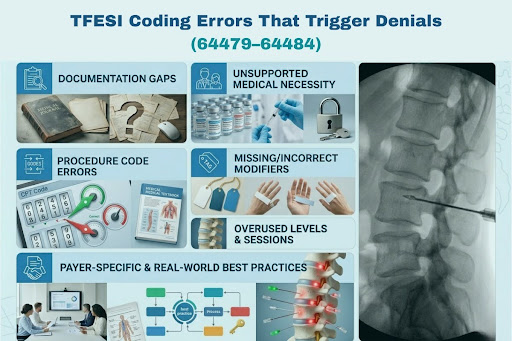
Transforaminal Epidural Steroid Injections (TFESIs) are commonly used to treat conditions such as radiculopathy, spinal stenosis, and herniated discs. Despite their clinical effectiveness, TFESIs remain one of the most frequently denied procedures from a billing and reimbursement standpoint.
The CPT code range 64479 to 64484 is used to report these injections, but errors in coding, insufficient documentation, and inconsistent interpretation of payer guidelines often result in claim denials, payment delays, and revenue leakage.
For billing teams, providers, and revenue cycle managers, a strong understanding of TFESI coding is essential not only for compliance but also for ensuring accurate reimbursement.
This guide will cover:
- Overview of CPT codes 64479–64484
- Common coding errors that trigger denials
- Documentation requirements
- Payer-specific challenges
- Real-world scenarios
- Best practices to reduce denials
Overview of TFESI CPT Codes (64479–64484)
Before diving into errors, it’s critical to understand how these codes are structured.
Code Breakdown
- 64479: Injection(s), anesthetic agent and/or steroid, transforaminal epidural, with imaging guidance; cervical or thoracic, single level
- 64480: Each additional level (cervical/thoracic)
- 64483: Lumbar or sacral, single level
- 64484: Each additional level (lumbar/sacral)
Key Characteristics
- Imaging guidance is included in the code
- Add-on codes (64480, 64484) must be used correctly
- Reported based on:
- Region (cervical/thoracic vs lumbar/sacral)
- Number of levels injected
Why TFESI Claims Are Frequently Denied
TFESI procedures are high-risk from a billing perspective because:
- High utilization attracts payer scrutiny
- Frequent audits by Medicare and commercial insurers
- Strict documentation requirements
- Confusion between similar spinal injection codes
Even small errors can result in:
- Claim denials
- Downcoding
- Audit flags
Common TFESI Coding Errors That Trigger Denials
Despite clear coding guidelines, TFESI claims are frequently denied due to recurring errors that can be avoided with proper understanding and attention to detail.
1. Incorrect Level Reporting
The Problem
Providers often:
- Miscount levels
- Bill add-on codes incorrectly
Example
If two lumbar levels are injected:
Correct coding:
- 64483 (first level)
- +64484 (second level)
Common Mistake
Billing 64483 twice instead of using add-on code
➡️ Result: Denial or reduced payment
2. Billing Bilaterally Incorrectly
The Issue
TFESIs can be performed:
- On one side (unilateral)
- On both sides (bilateral)
Common Errors
- Failing to use modifier -50 (if required)
- Billing two line items incorrectly
Important Note
Payer rules vary:
- Some require modifier -50
- Others require RT/LT modifiers
- ➡️ Always verify payer-specific guidelines
3. Confusion Between Regions
The Problem
Incorrectly coding:
- Cervical/thoracic vs lumbar/sacral
Example
Using 64479 for lumbar injection
➡️ Incorrect region coding leads to denial
4. Missing or Incorrect Imaging Documentation
Key Rule
Imaging guidance is mandatory and included in TFESI codes.
Common Mistakes
- Not documenting fluoroscopy or CT guidance
- Billing imaging separately (which is incorrect)
➡️ Leads to:
- Denials
- Compliance issues
5. Reporting Multiple Units Incorrectly
The Issue
TFESI codes are:
- Reported per level
- Not per injection
Mistake
Billing multiple units instead of add-on codes
➡️ Results in claim rejection
6. Lack of Medical Necessity
The Biggest Denial Trigger
Payers require:
- Clear indication for TFESI
Missing Documentation
- Diagnosis supporting radiculopathy
- Conservative treatment failure
- Imaging findings
➡️ Without this, claims are denied
7. Using Incorrect Diagnosis Codes
Common Errors
- Using generic back pain codes
- Not linking diagnosis to nerve root involvement
Better Approach
Use:
- Specific ICD-10 codes (e.g., radiculopathy)
8. Overuse of Add-On Codes
Problem
Billing:
- More levels than documented
Example
Claim shows 3 levels
Documentation supports only 2
➡️ Triggers audit and denial
9. Not Following Frequency Limits
Payer Rules
Most insurers limit:
- Number of injections per year
Mistake
Exceeding allowed frequency
➡️ Claim denied as medically unnecessary
10. Modifier Misuse
Common Issues
- Missing modifiers
- Incorrect modifier combinations
Examples:
- Missing RT/LT
- Incorrect use of -59
Documentation Requirements for TFESI
Accurate and comprehensive documentation is essential for supporting medical necessity, ensuring compliance, and preventing claim denials. Incomplete or unclear documentation is one of the leading causes of reimbursement issues in TFESI billing.
Must Include
To support proper coding and claim approval, documentation should clearly capture:
- Patient diagnosis that justifies the procedure
- Specific level(s) injected, including anatomical location
- Laterality (right, left, or bilateral) where applicable
- Confirmation of imaging guidance (such as fluoroscopy or CT)
- Detailed procedure notes, including technique and medications used
Additional Requirements
In addition to procedural details, documentation should also demonstrate medical necessity by including:
- Evidence of failed conservative treatment (e.g., physical therapy, medications)
- Clear clinical justification for performing the injection
Real-World Denial Scenarios
The following examples highlight how common mistakes lead to claim denials in practice.
Scenario 1: Incorrect Add-On Usage
Claim:
64483 billed twice
Issue:
Should use 64483 + 64484
Result:
Denial
Scenario 2: Missing Imaging
Documentation:
No mention of fluoroscopy
Result:
Claim denied
Scenario 3: Wrong Region Code
Procedure:
Lumbar injection
Billed:
64479
Result:
Denial
Scenario 4: Lack of Medical Necessity
Diagnosis:
General back pain
Result:
Denial
Payment and Reimbursement Challenges
Reimbursement for TFESI procedures comes with several challenges that providers must navigate carefully.
1. High-Scrutiny Procedures
TFESIs are considered high-risk from a billing perspective due to their frequency and cost. As a result, they are:
- Frequently subject to payer audits and reviews
- Closely monitored for overutilization or inappropriate use
Even minor discrepancies in documentation or coding can trigger denials or post-payment audits.
2. Payer Variability
Reimbursement rules for TFESI procedures can differ significantly across payers. Each insurer may have its own:
- Coding and modifier requirements
- Coverage policies and medical necessity criteria
- Limits on frequency and number of levels treated
Many payers also require prior authorization, making it critical to verify requirements before the procedure is performed.
3. Bundling and Coding Issues
Improper coding can result in services being unintentionally bundled, leading to reduced or denied reimbursement. Common issues include:
- Incorrect use of primary and add-on codes
- Failure to follow payer-specific billing rules
- Reporting multiple units instead of appropriate add-on codes
Accurate coding is essential to ensure that each level and service is properly recognized and reimbursed.
4. Pre-Authorization Requirements
A significant number of payers require prior authorization for TFESI procedures. Failure to obtain approval can result in:
- Immediate claim denial
- Delayed reimbursement
- Increased administrative burden for resubmissions
Ensuring that authorization is secured and documented before the procedure is critical for claim success.
Best Practices to Avoid TFESI Denials
Reducing denials for TFESI procedures requires a proactive and detail-oriented approach. By implementing the following best practices, providers and billing teams can improve claim accuracy, enhance reimbursement outcomes, and maintain compliance.
1. Ensure Accurate Level Reporting
Always report the correct combination of primary and add-on codes based on the number of levels treated. Avoid common errors such as:
- Billing the primary code multiple times instead of using add-on codes
- Miscounting the number of levels injected
Accurate level reporting is critical to preventing claim rejections and payment reductions.
2. Verify Payer-Specific Guidelines
Each payer may have unique requirements for TFESI billing. It is essential to:
- Confirm correct modifier usage (such as RT, LT, or -50)
- Review billing rules and coverage policies
- Check for frequency limits and authorization requirements
Verifying these details before submission can significantly reduce denials.
3. Strengthen Documentation Practices
Comprehensive documentation is key to supporting medical necessity and ensuring claim approval. Make sure to include:
- Clear diagnosis supporting the procedure
- Specific levels and laterality treated
- Confirmation of imaging guidance
- Detailed procedure notes
Strong documentation not only supports reimbursement but also protects against audits.
4. Use Accurate and Specific Diagnosis Codes
Avoid using vague or non-specific diagnosis codes such as general back pain. Instead:
- Use condition-specific codes (e.g., radiculopathy)
- Ensure diagnoses are directly linked to the treated level and symptoms
Accurate diagnosis coding strengthens medical necessity and improves claim acceptance rates.
5. Conduct Regular Claim Audits
Routine audits help identify recurring errors and missed opportunities. Practices should:
- Review denied claims to identify patterns
- Correct coding and documentation issues promptly
- Implement process improvements based on findings
Regular audits play a crucial role in maintaining billing accuracy and optimizing revenue cycle performance.
Strategic Role in Revenue Cycle Management
TFESI coding plays a critical role in revenue cycle management due to its direct impact on both reimbursement potential and denial rates. As high-value procedures with strict payer scrutiny, even small coding or documentation errors can lead to significant revenue loss.
Why It Matters
Effective management of TFESI billing is essential because these procedures:
- Represent high-reimbursement services, making them a key contributor to overall practice revenue
- Carry a high risk of denials due to complex coding requirements and stringent payer policies
- Are frequently audited, increasing the need for accuracy and compliance
Strategic Approach
To optimize outcomes and minimize risk, practices should implement a structured strategy that includes:
- Training staff regularly on coding updates, documentation requirements, and payer-specific rules
- Standardizing coding workflows to ensure consistency across all claims
- Monitoring denial trends to quickly identify recurring issues and implement corrective actions
Future Trends in TFESI Billing
The environment of TFESI billing is rapidly evolving as payers adopt more advanced review processes and stricter compliance standards. Providers and billing teams must stay ahead of these changes to maintain reimbursement accuracy and minimize denials.
Key Trends to Watch
- Increased Payer Scrutiny: Insurance companies are applying more rigorous review criteria, especially for high-cost and frequently performed procedures like TFESIs.
- AI-Driven Claim Audits: Advanced analytics and artificial intelligence are being used to detect coding inconsistencies, overutilization, and documentation gaps.
- Stricter Documentation Requirements: Payers are demanding more detailed and precise documentation to justify medical necessity and procedural accuracy.
What to Expect Moving Forward
- Higher Denial Rates for Incomplete Documentation: Claims lacking sufficient detail or clinical justification are more likely to be denied or delayed.
- Greater Reliance on Data Accuracy: Accurate coding, correct modifier usage, and complete documentation will become even more critical in ensuring claim approval.
To maximize efficiency and reduce administrative burden, it’s worth exploring the benefits of hiring a medical billing company for your practice.
Key Takeaways
TFESI procedures offer significant clinical value, but their billing complexity makes them a high-risk area for denials. CPT codes 64479–64484 must be used with precision, supported by strong documentation, and aligned with payer-specific rules.
- Use correct codes based on region and levels
- Always document imaging guidance
- Avoid modifier errors
- Ensure medical necessity is clearly established
- Follow payer-specific policies
Before making a decision, explore the essential factors to look for when choosing a medical billing company.
Optimize TFESI Reimbursement with Summit RCM
TFESI billing is a complex, high-impact area where precision in coding and documentation directly determines reimbursement success. Even minor errors can lead to significant denials, making it essential for practices to adopt a structured and detail-oriented approach.
At Summit RCM, we specialize in simplifying complex interventional pain management billing through our Revenue Cycle Management Services, helping providers reduce denials, improve coding accuracy, and maximize reimbursement. Our team stays ahead of evolving payer requirements to ensure your TFESI claims are compliant, optimized, and consistently approved.
.png)